


Mortar and Pestle with Herbs: How to Choose One
Quick Answer
The best mortar and pestle for herbs depends on the task. For fresh herbs, choose a stable, easy-to-clean bowl and a comfortable pestle for controlled pressing and bruising. For dried herbs, prioritise weight, bowl depth, and enough interior friction for grinding. Match the material and size to your usual quantity, cleaning habits, and storage space.
Definitions
Mortar
The bowl-shaped vessel in which herbs are held, crushed, bruised, or ground.
Pestle
The handheld tool used to press, crush, bruise, or grind ingredients inside the mortar.
Non-porous surface
A surface that does not readily absorb moisture, oils, colours, or odours, making it generally easier to clean.
Surface texture
The smoothness or roughness of the mortar’s interior, which affects grip, friction, and how herbs break down.
Mortar and Pestle with Herbs: How to Choose One
There is no single best mortar and pestle for every herb task. Fresh leaves usually benefit from controlled crushing, a bowl that contains moisture, and simple cleanup. Dried herbs generally need greater stability and useful friction to break down evenly.
Start with what you use most often, then consider the quantity, your preferred texture, how promptly you like to clean up, and the storage room you have. A small smooth bowl may be ideal for a few fresh leaves, while a heavier, deeper option can feel more practical for repeated dried-herb grinding.
- Fresh and moist herbs: prioritise control, containment, and easy cleaning.
- Dry and brittle herbs: prioritise stability, depth, and grinding friction.
- Frequent mixed use: look for a balanced medium-size mortar with practical care requirements.
What Makes a Mortar and Pestle Suitable for Herbs?
A useful herb mortar and pestle stays steady while you work. A substantial base or non-slip underside can reduce movement during pressing and circular grinding. The bowl should be rounded enough to bring herbs back towards the pestle, with enough depth to limit scatter.
Pestle shape matters as much as bowl material. Choose one that sits securely in your hand and has a working end broad enough to bruise leaves or contact dried herbs effectively. The opening should also give you space to add, turn, and remove ingredients without crowding.
Crushing and grinding are related but different actions. Crushing bruises fresh leaves and releases their aroma with pressing motions; grinding asks for more friction and repeated movement to reduce dry, brittle herbs.
- Stable base for safer, more controlled work.
- Rounded, moderately deep bowl to keep herbs in the working area.
- Comfortable pestle grip and a practical working end.
- Capacity that fits your normal batch rather than the largest possible batch.
Fresh Versus Dried Herbs: A Practical Choice Framework
Fresh herbs are moist, flexible, and prone to sticking to the bowl. A smooth, easy-clean surface and a pestle that lets you press and bruise without excessive force are useful priorities. A bowl that is too wide can make a few leaves difficult to gather, so choose a size that suits your usual handful or garnish-sized quantity.
Dried herbs are more brittle and often need steady circular grinding. Weight, bowl depth, and moderate interior texture can help keep the mortar stable and give the herbs something to work against. For both fresh and dried use, a medium-capacity, non-porous mortar is often a practical compromise if its base is stable and pestle feels comfortable.
- Choose fresh herbs: focus on cleanup, containment, and gentle control.
- Choose dried herbs: focus on friction, stability, and bowl depth.
- Choose mixed use: seek a balanced medium capacity and straightforward care.
- For very small quantities, avoid an oversized bowl that leaves herbs out of reach.
Stone, Wood, Ceramic, and Metal: Which Material Fits Your Herbs?
Stone, including marble, is substantial and can be a practical direction for dried-herb grinding because its weight helps it stay in place. Surface finish and porosity vary, however, so follow the maker’s care guidance rather than assuming all stone is treated the same way.
Wood is lightweight, warm in appearance, and appealing for a rustic kitchen. It needs attentive drying after washing and may be more susceptible than non-porous materials to taking on moisture, colour, or aroma over time.
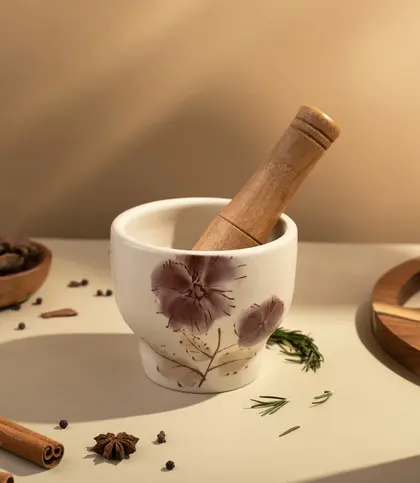
Ceramic and porcelain usually offer a relatively smooth surface that is convenient for everyday cleaning and fresh-herb use. Handle them according to the manufacturer’s guidance, particularly if you plan to use firm, forceful grinding motions. Stainless steel is non-porous and generally practical for managing stains and odours, though its actual weight, grip, and interior finish still determine how it performs.
- Stone or marble: substantial and well suited to a stable grinding setup.
- Wood: lightweight and characterful, with more careful moisture management.
- Ceramic or porcelain: smooth and convenient for routine cleanup.
- Stainless steel: non-porous, while texture and base stability remain important.
Choosing Bowl Capacity, Shape, and Pestle Grip
Small mortars suit a few leaves, a garnish-sized amount, or pinches of dried herbs. They save space, but can feel cramped if you prepare several batches. Medium capacity is the most adaptable starting point for many homes, giving you room to turn herbs without taking over a cupboard.
A large bowl is helpful for bigger batches and allows freer hand movement, but it may be inefficient when you only need a pinch. Look for a rounded bowl with moderate depth: it should contain herbs during use without making the last fragments difficult to scrape out.
Check the pestle in relation to the bowl. It should be long enough for a comfortable hold, broad enough to make contact with the herbs, and shaped to remain secure in your hand. A stated capacity, such as 600 ml, is a useful comparison point, not a precise indication of its comfortable working fill level.
- Small: best for pinches and a few leaves.
- Medium: a flexible everyday choice for crushing and short grinding tasks.
- Large: useful for bigger batches, but less efficient for tiny quantities.
- Choose a rounded, moderately deep bowl and a secure pestle grip.
Does a Rough Surface Grind Herbs Better?
A textured interior can help dried herbs catch against the bowl instead of slipping beneath the pestle. That added friction may make grinding easier, especially when the herbs are fully dry and brittle. It is not the only factor, though: bowl stability, pestle shape, pressure, and the dryness of the herbs all affect the result.
A smoother interior is easier to wipe down and can be more appealing for moist fresh herbs, particularly when staining or lingering aromas are a concern. Very rough or uneven finishes can hold fine particles, so inspect the surface and care instructions before making a choice.
Think of texture as a trade-off between friction and maintenance. Choose enough texture for your usual dried-herb work, but do not assume that the roughest surface will always perform best or be easiest to live with.
- Textured interiors may help dry herbs grip during grinding.
- Smooth interiors generally simplify cleanup after moist herb use.
- Pestle design, pressure, and bowl stability matter alongside texture.
Cleaning, Odour Retention, Staining, and Maintenance
Remove herb residue soon after use, before moisture and fine particles have time to settle into the finish. Use the cleaning method recommended by the manufacturer, especially when the product has a natural, textured, glazed, or coated surface.
Porcelain, ceramic, and stainless steel are generally easier to clean thoroughly than more absorbent or heavily textured materials. Stone can hold residue in natural surface variations, so dry it fully after washing and do not assume every stone finish is dishwasher-safe. Wood should not be left soaking; wash it gently, dry it completely, and follow any care or conditioning instructions provided.
Strongly coloured or aromatic herbs can leave marks or odours, but the degree depends on material, finish, and porosity. Avoid harsh cleaners and aggressive abrasives unless the product’s care instructions specifically support them.
- Clean promptly after use to limit residue and odour transfer.
- Dry stone and wood thoroughly before storing.
- Do not soak wood.
- Follow the individual product’s care instructions for cleaners and washing methods.
When Is a Mortar and Pestle Better for Herbs?
A mortar and pestle is especially useful for small quantities, controlled crushing, bruising, and adjusting texture by hand. It gives you the option to stop when leaves are merely bruised or continue until dried herbs are more finely ground.
Chopping can be simpler when herbs should remain leafy and roughly cut rather than crushed. A powered appliance may be more practical for large batches or when speed is the main concern, but manual crushing is often more satisfying when control, compact storage, and small-batch preparation matter most.
- Choose it for hands-on control over texture.
- Use it for small batches and deliberate bruising or grinding.
- Consider chopping for leafy, roughly cut herbs.
- Choose another processing method when very large volume or speed is the priority.
A Quick Buying Checklist for Herb Use
For fresh herbs, choose an easy-clean surface, a manageable bowl size, and a pestle that feels comfortable for pressing. For dried herbs, look for a stable, substantial mortar with enough depth and suitable texture for grinding. If you expect to do both, a medium-capacity option with a stable base and straightforward care is a sensible place to begin.
For catalog comparisons, the OpalCraft Mortar & Pestle (600 ML) - Single Piece provides a porcelain option for readers considering a smooth-surface mortar. The Jalidar Mortar And Pestle Set represents a wood alternative for those who prefer a lightweight, rustic material. If traditional marble appeals to your routine, compare the Eclipse Marble Mortar & Pestle with the Zelvora Mortar and Pestle Set - Two Piece Set, then check their dimensions, finish, weight, and care guidance before choosing.
- Fresh herbs: easy-clean surface, manageable capacity, comfortable pestle.
- Dried herbs: stable, substantial bowl, practical depth, useful friction.
- Mixed use: medium capacity, stable base, and balanced maintenance needs.
- Rustic and lightweight: wood, with closer attention to moisture and odour absorption.
- Stone preference: compare marble options by their listed dimensions, finish, and care information.
Final Verdict: Match the Tool to the Herb
Choose by herb condition first. Fresh leaves call for controlled crushing and easy cleanup, while frequent dried-herb grinding benefits from weight, stability, and useful friction. Then narrow your choice by capacity, bowl depth, pestle grip, surface finish, and the level of maintenance you are willing to take on.
Stone is a practical direction for regular dried-herb grinding, while porcelain or ceramic-like smooth surfaces can suit fresh herbs and simpler cleanup. Neither is universally superior: the right mortar and pestle is the one that matches your usual quantities, handling style, and care routine. Check dimensions, weight, finish, and manufacturer care instructions before purchase.
Compare mortar-and-pestle materials
The current examples below include products listed as marble and other mortar-and-pestle constructions. Use the material, bowl capacity, interior texture, pestle grip, and cleaning framework above rather than choosing on appearance alone.
Confirm food-contact guidance, exact material and finish, usable capacity, seasoning requirements, porosity, stain or odour retention, and care instructions on the individual product page.
₹475
₹725
34%OFF

₹2,266
₹2,450
8%OFF

₹699
₹1,378
49%OFF

Final Verdict
- Choose based on whether you mainly crush fresh herbs or grind dried ones.
- For fresh herbs, favour control, containment, and straightforward cleanup.
- For dried herbs, favour a stable bowl, comfortable pestle, adequate depth, and useful friction.
- Confirm the material finish, dimensions, weight, and care guidance before deciding.
FAQs
Which mortar and pestle material is best for fresh herbs?
A smooth, easy-clean porcelain or ceramic-like surface is often a practical match for fresh herbs because moist leaves are easier to remove after pressing. Choose a size that lets you gather the quantity you normally use.
What is the best mortar and pestle for dried herbs?
For dried herbs, look for a stable, substantial mortar with enough bowl depth and a finish that provides useful friction. Stone or marble can be a practical direction, but the exact finish, weight, and care requirements still matter.
What size mortar and pestle is practical for herbs?
A small mortar works for pinches and a few leaves, while a medium bowl is usually the most flexible choice for everyday kitchen use. Large bowls suit larger batches but can make tiny quantities harder to work with.
Does a rough surface grind herbs better?
Texture can help dry herbs grip during grinding, but it is not a guarantee of better results. Pestle shape, pressure, bowl stability, and herb dryness also matter, while smoother surfaces are usually easier to clean.
How do you clean a mortar and pestle after using herbs?
Remove residue promptly and follow the manufacturer’s cleaning guidance. Dry the mortar fully before storage, avoid soaking wood, and do not assume stone or other materials are dishwasher-safe without specific care instructions.
Which mortar and pestle materials retain odours?
Odour retention depends on the surface finish and porosity. Wood and more porous or textured materials may need more attentive cleaning and drying, while non-porous porcelain, ceramic, and stainless steel are generally easier to clean thoroughly.
Is a mortar and pestle better than an electric grinder for herbs?
A mortar and pestle is often better for small quantities and hands-on control over bruising and texture. An electric grinder may be more practical for larger quantities or speed, but it offers a different workflow.