Quick Answer
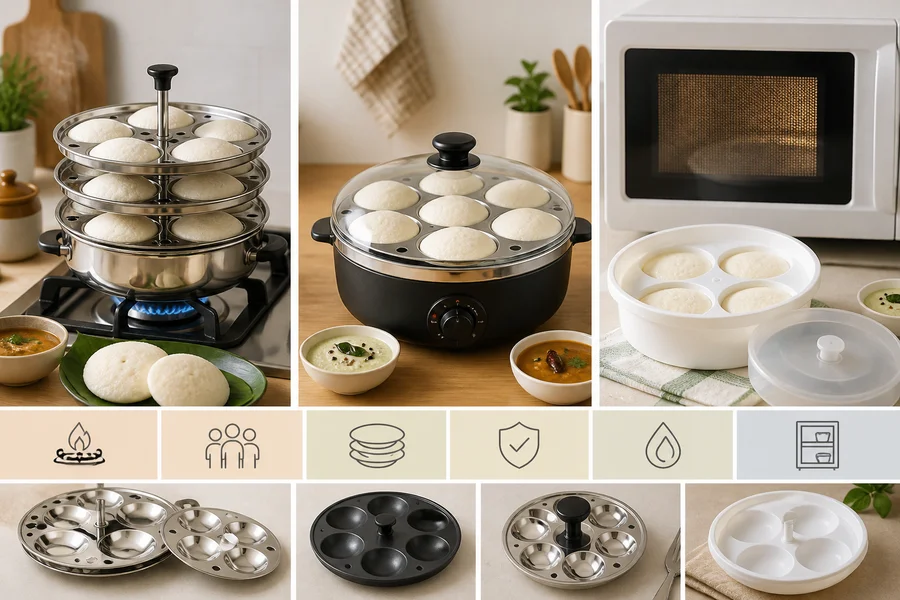
The best idli maker depends on how you cook and how many people you serve. Choose a stovetop model for familiar steaming and flexible batch sizes, an electric model for a dedicated plug-in setup, or a microwave-safe mould for compact, occasional use. Check capacity, heat compatibility, material, cooker fit, cleaning and storage before buying.
Definitions
Stovetop idli maker
A stackable idli steaming setup used over a compatible gas, induction or other stovetop heat source, depending on its base material and product design.
Electric idli maker
A plug-in appliance with its own heating system and idli moulds, intended for users who prefer a dedicated countertop setup.
Microwave idli maker
A microwave-safe mould or container designed to cook idli batter using microwave heating rather than direct stovetop steam.
Idli plate
A removable tray with round cavities for holding idli batter; plates may be used inside a compatible idli vessel, cooker or steamer.
Batch capacity
The number of idlis that can be prepared in one cooking cycle, which may depend on the number of cavities and stacked plates.
Best idli maker: choose by cooking setup, not just by product type
There is no single best idli maker for every home. The right choice starts with your available cooking setup, then comes down to the number of people you serve, the material you prefer and the storage space you can spare.
A stovetop maker is a practical fit if you already steam food on a gas hob and want a familiar, stackable format. An electric maker can suit a household that prefers a dedicated plug-in appliance on the counter. A microwave-safe idli mould can make sense for small, occasional batches in a compact kitchen.
Before deciding, confirm the heat source, plate or mould capacity, material care, fit with any existing cooker or steamer, and how easily the parts can be washed and stored.
- Choose stovetop for a familiar steaming workflow and potentially larger batches.
- Choose electric when a dedicated plug-in setup suits your counter routine.
- Choose microwave only when the mould is explicitly marked microwave-safe.
- Prioritise compatibility and capacity over appearance alone.
Idli Maker

₹2,294
₹3,350
32%OFF

₹2,082
₹3,035
31%OFF

₹1,377
₹1,540
11%OFF

₹1,019
₹1,460
30%OFF

₹1,444
₹2,120
32%OFF

₹892
₹1,260
29%OFF
₹5,999
₹12,000
50%OFF
₹999
₹1,199
17%OFF
Stovetop, electric or microwave: which setup fits your kitchen?
Stovetop idli makers use steam from water in the vessel beneath the plates. They suit cooks who are comfortable managing a hob and want to inspect the water level, vessel stability and plate placement themselves. For gas use, check that the base sits steadily on the burner. For induction, rely only on an explicit induction-compatibility statement rather than assuming all stainless-steel makers will work.
Electric idli makers are self-contained plug-in appliances with their own heating design and mould arrangement. Check the socket location, counter footprint, cord storage, mould capacity and the manufacturer’s heating and cleaning guidance before choosing one. A dedicated appliance can simplify the setup, but it still needs a convenient place to live between uses.
Microwave idli makers are intended for microwave heating and should be used only when the product is clearly labelled microwave-safe. Follow its stated fill level and heating instructions. Do not place a metal idli plate or an unlabelled container in the microwave.
If you already own a suitable pressure cooker or steamer, separate idli plates may be useful after you have measured the internal space and support arrangement. A complete maker is often simpler when you want one dedicated steaming setup.
- Stovetop: check hob suitability, stable placement, water capacity and easy plate lifting.
- Electric: check plug-in needs, counter space, mould layout and storage.
- Microwave: verify microwave-safe marking and follow the supplied instructions.
- Separate plates: measure your existing cooker or steamer before purchase.
₹2,294
₹3,350
32%OFF
How many idlis should one batch make?
Batch size should match your normal breakfast rather than the biggest gathering you host once in a while. A compact maker can be easier to store and handle, but a larger household may find repeated steaming rounds inconvenient.
For one or two people, a modest multi-plate format can be a sensible starting point if it fits your usual serving needs. For regular family breakfasts, look at the stated plate count or listed capacity and choose a setup that reduces unnecessary repeat cycles. Larger makers are useful when several people eat together or idli is prepared often.
Do not estimate an exact number of idlis from a vessel’s dimensions alone. Use the listed plate count, cavity count or stated product capacity where available. Also allow room to lift the stack safely and ensure the vessel holds enough water for steaming.
- Small-batch formats suit occasional use, smaller households and limited storage.
- Standard-batch formats suit frequent everyday breakfasts.
- Large formats can reduce repeat cooking cycles for larger households.
- Check the stated capacity rather than inferring an exact idli count.

Sold Out
₹1,572
₹2,300
32%OFF

Sold Out
₹1,954
₹2,850
31%OFF
₹2,082
₹3,035
31%OFF
Material guide: stainless steel, aluminium, non-stick and microwave-safe plastic
Stainless steel is a common choice for stovetop idli makers and is straightforward to inspect. Look beyond the material name: check the plate fit, seams, handles, lid and overall stability. If induction cooking matters, confirm that the particular base is marked compatible.
Aluminium may be lighter to handle, but buyers should confirm its intended heat source, construction and care instructions. A non-stick surface may help with release and cleaning when it is used and maintained as directed, but coating condition, batter consistency and utensil choice all affect results.
Microwave-safe plastic is relevant only for microwave use. Confirm explicit microwave-safe labelling and do not use it on a direct flame, stovetop or in an oven unless the product information specifically permits that use. For any mould, a light coating of oil and a short rest after heating may help release the idlis, depending on the batter and instructions.
- Stainless steel: inspect construction, handles and plate fit.
- Aluminium: confirm heat-source suitability and care requirements.
- Non-stick: check coating guidance and use suitable utensils.
- Microwave-safe plastic: use only as explicitly instructed for microwave heating.
₹999
₹1,199
17%OFF
Compatibility, cleaning and storage checks
When buying separate plates, measure the inside diameter and usable height of your pressure cooker or steamer first. You also need to know whether there is a suitable stand, stem or support for the plates, and whether the lid can close without touching the top plate.
For any stovetop model, check that it is stable on your hob and that the plates can be removed safely while hot. If you use induction, verify induction compatibility from the listing or product information. Stainless steel alone is not enough confirmation.
Cleaning is easier when cavities, edges and plate surfaces are accessible. Removable parts can be useful, but always follow the care guidance for the specific material. Finally, consider the stacked height in a cabinet and whether the lid, handles and plates nest securely without awkward balancing.
- Measure cooker or steamer diameter and height before buying separate plates.
- Check whether a stand, separator, stem and lid are included.
- Confirm induction compatibility explicitly where needed.
- Choose surfaces and cavities you can comfortably wash and dry.
- Check stored height and plate nesting before purchase.
₹899
₹1,400
36%OFF
Practical idli maker buying checklist
Use this checklist to narrow the choice quickly. A maker that looks attractive but does not suit your hob, microwave, cooker or cabinet will be less useful than a simple model that fits your routine.
Compare confirmed specifications and care information rather than assuming that a higher price or a larger-looking vessel will perform better for your household.
- Cooking method: gas, induction-compatible stovetop, electric or microwave.
- Capacity: mini, small batch, standard batch or large batch.
- Format: complete maker, removable plates or a dedicated electric or microwave container.
- Compatibility: cooker or steamer fit, heat source, microwave-safe marking and lid clearance.
- Material: stainless steel, aluminium, non-stick or microwave-safe plastic, with care instructions checked.
- Handling: stable stack, secure handles, easy plate removal and a suitable lid.
- Maintenance: washable cavities and care requirements your household will follow.
- Storage: total height, nesting design and available shelf or cabinet space.
How to use an idli maker for the first time
Before first use, wash the moulds, plates and vessel according to the product’s material and care instructions. Lightly grease the cavities if recommended, then add prepared idli batter without overfilling them.
For a stovetop maker, add the required water to the vessel, position the plates securely, cover with the lid and heat according to the product instructions. For electric and microwave models, follow their supplied heating, fill-level and resting guidance rather than using stovetop instructions.
Use suitable hand protection to lift hot parts. Let the idlis rest briefly, then loosen the edges with a utensil that is compatible with the surface. Allow all parts to cool before washing, and avoid abrasive tools or metal utensils if the care instructions advise against them.
- Wash all parts before first use.
- Fill cavities evenly without overfilling.
- Use the heating method and fill level specified for the product.
- Lift hot plates carefully and allow a short rest before releasing idlis.
- Cool parts before cleaning.
Quick recommendations by household use case
For a gas-stove household, a compatible stovetop idli maker is usually the most natural choice, especially when you already steam food on the hob. For an induction kitchen, choose only a maker with confirmed induction compatibility, or consider idli plates that work inside separately compatible cookware.
For one or two people, focus on a compact design that is easy to store and does not create more food than you need. For a larger family or frequent idli breakfasts, prioritise a larger multi-plate setup, stable stacking and enough clearance to lift hot plates comfortably.
For a small kitchen, compare stored height and nesting as carefully as cooking capacity. For occasional microwave use, select only an explicitly microwave-safe mould and follow its instructions exactly.
- Gas stove: choose a stable, compatible stovetop setup.
- Induction: require explicit compatibility confirmation.
- One or two people: favour manageable capacity and compact storage.
- Larger families: favour more plates and safe handling space.
- Small kitchens: check nesting and cabinet height.
- Microwave use: select only clearly microwave-safe parts.
Final Verdict
- The best idli maker is the one that matches your cooking setup and household serving pattern, not a universally superior format.
- Choose stovetop for familiar steaming and flexible batch choices, electric for a dedicated plug-in counter workflow, and microwave-safe moulds for compact occasional use.
- Within any format, check capacity, cooker or steamer fit, material care, safe lifting, cleaning and storage before making the final decision.
FAQs
Which type of idli maker is best for a gas stove?
A compatible stovetop idli maker is generally the most practical choice for a gas stove. Check that the vessel sits steadily on the burner, the lid fits securely and the plates can be lifted safely when hot.
Can an idli maker be used on an induction hob?
Only if the product or its base is explicitly stated to be induction-compatible. Do not assume that every stainless-steel idli maker will work on induction.
How many idlis should an idli maker make in one batch?
Choose by your usual serving needs. Smaller households may prefer a compact format, while frequent family breakfasts may justify a larger multi-plate setup. Use the listed cavity count, plate count or capacity instead of guessing from dimensions.
Are stainless steel idli makers better than non-stick ones?
They suit different priorities. Stainless steel is a common stovetop choice and is easy to inspect, while non-stick surfaces may assist release when cared for correctly. Check heat limits, coating care and suitable utensils before deciding.
Can idli plates fit inside an existing pressure cooker?
They may, but fit is not automatic. Measure the cooker’s internal diameter and usable height, then check the plate support, stem or stand arrangement and whether the lid closes properly.
How does a microwave idli maker work?
A microwave idli maker uses a microwave-safe mould or container to heat batter in the microwave. Use only a product with clear microwave-safe labelling, follow its fill-level instructions and never use metal plates in the microwave.
What should I check before buying an idli maker?
Check your cooking method, capacity needs, material, cooker or steamer fit, induction or microwave compatibility, handling, cleaning requirements and storage dimensions.
How do I use and clean an idli maker?
Wash it before use, grease cavities if recommended, avoid overfilling and follow the product-specific steaming or heating instructions. Let hot parts cool before washing, and use only the utensils and cleaning tools allowed for its material.
Keep exploring