


Dosa Tawa Best Company: Compare Options for Your Kitchen
Quick Answer
There is no single best dosa tawa company for every kitchen. Compare the exact product’s documented cooktop compatibility, material, diameter, care requirements, and available policy information, then choose the profile that best suits how you cook.
Definitions
Cooktop compatibility
Whether the specific dosa tawa is designed for gas, induction, or both. Verify this in the product specifications or manufacturer guidance.
Construction
How the tawa is made, including the base, thickness where disclosed, surface finish, and handle attachment.
Coating disclosure
Clear information about whether the cooking surface is non-stick, enamelled, seasoned, or uncoated, along with stated care limitations.
After-sales support
Help available for product issues through warranty service, returns, replacements, accessible support channels, and relevant spare parts where available.
Dosa Tawa Best Company: What Should You Actually Compare?
There is no universal best dosa tawa company because the right choice changes with your stove, preferred material, maintenance tolerance, household size, and expectations after purchase. A company may offer a product profile that suits frequent traditional cooking, while another may better suit lighter everyday handling.
Start with the specific dosa tawa rather than a broad company reputation. The most useful comparison is based on what is clearly documented for that model: material, diameter, cooktop compatibility, surface and care guidance, plus any available warranty, return, replacement, and support information.
- Compare named product profiles only through supported specifications.
- Treat missing compatibility, surface-care, or policy details as points to verify.
- Choose a fit for your routine rather than looking for an unsupported overall winner.
The Criteria for Comparing Dosa Tawa Companies
A transparent company comparison separates known product details from information that has not been verified. Material and diameter can help identify whether a tawa may suit a particular cooking style, but they do not prove induction suitability, ease of maintenance, heat performance, or company-wide service quality.
Give greater weight to clear product documentation than broad marketing language. If two options otherwise fit your needs, clarity around care instructions and purchase policies can be a practical way to decide between them.
- Check the exact model’s stated gas, induction, or dual-cooktop compatibility.
- Compare material, cooking-surface disclosure, base design, diameter, weight, and handle details where provided.
- Review care instructions before choosing a traditional or coated surface.
- Check exact warranty, return, replacement, and support terms before ordering; these details are not verified here for the featured examples.
Gas, Induction, or Dual-Compatible: Begin With Your Stove
For a gas stove, assess the stated base design, diameter, stability on burner supports, and handle clearance. A tawa should be practical for the burner area and comfortable to manage while cooking.
For induction, require an explicit compatibility statement for the exact product and follow the manufacturer’s instructions. Do not assume that cast iron or aluminium alone confirms induction use. If your kitchen uses both gas and induction, choose only from products clearly described as suitable for both when that flexibility matters.
- Check the current listing and manufacturer guidance for the precise tawa.
- Match the cooking area to your burner or induction zone.
- Allow for handle clearance, safe lifting, and storage space.
Material, Coating, and Construction: What Separates Companies?
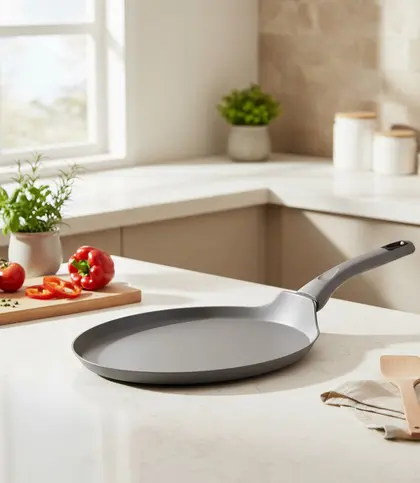
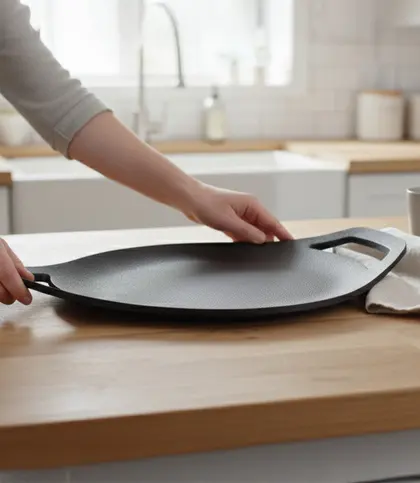
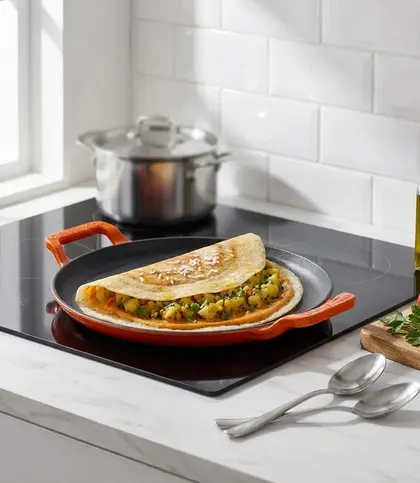
The available product profiles illustrate three distinct starting points: cast aluminium, cast iron, and enamel cast iron. Wellberg’s listed profile is a 29 cm cast-aluminium dosa tawa, Duogrip’s is a 26 cm cast-iron dosa tawa, and Cumin Co’s is a 30 cm enamel cast-iron dosa tawa. These material and size differences can help readers identify which company profile merits closer consideration.
Cast iron can appeal to cooks who prefer traditional cookware and are willing to follow the specific product’s drying, seasoning, and rust-prevention guidance where required. Cast aluminium can be appealing when lighter handling is a priority, while enamel cast iron may suit readers considering an enamelled traditional-style format. Surface treatment, heat limitations, utensil guidance, cleaning requirements, and cooktop compatibility must still be checked on each exact listing.
- Use material as a guide to likely care expectations, not as proof of universal performance.
- Look for clearly disclosed surface-care and utensil-use instructions.
- Balance useful stability against comfortable everyday lifting.
- Check that the handle and base design suit your cooking and storage routine.
Choosing the Right Dosa Tawa Size
Compare listed diameters instead of relying on labels such as small, medium, or large. Among the supplied examples, the Duogrip option is listed at 26 cm, the Wellberg option at 29 cm, and the Cumin Co option at 30 cm. Those measurements create different cooking-area and storage considerations without establishing a ranking.
A smaller listed diameter may suit limited storage or modest portions. A larger cooking area may be more useful for family-sized dosas, provided it is practical for your burner coverage, cabinet space, and lifting comfort. Measure the space available with the handle included before deciding.
- Choose a diameter that fits your desired dosa size and burner area.
- Consider storage depth and total handle length.
- Select a weight and size you can control comfortably every day.
Which Company Profile Fits Your Cooking Style?
For frequent dosa making, a cast-iron profile such as the supplied Duogrip example may be worth exploring if you want traditional cookware and can follow the exact care guidance. Its listed 26 cm size may appeal to cooks whose portions, burner space, and storage suit that diameter; compatibility and maintenance details should be confirmed before purchase.
For regular household use where manageable handling is important, the supplied Wellberg cast-aluminium profile offers a different material and 29 cm size to compare. For households seeking a larger listed cooking area and considering enamel cast iron, the supplied Cumin Co 30 cm profile is another distinct option. These are use-case pathways, not evidence that any company is better overall.
Warranty, returns, availability, support quality, and other company-policy details have not been verified for these profiles. Review current product and seller information directly before using those factors to break a close comparison.
- Frequent traditional cooking: compare cast-iron profiles with care requirements you will realistically follow.
- Everyday handling: compare material, diameter, handle design, and disclosed surface-care guidance.
- Family cooking: check whether the listed diameter remains manageable for your burner and storage.
- Use policy clarity only after verifying the terms for the exact product.
How to Read Product Options Without Assuming a Universal Winner
The Wellberg Matte Finish Cast Aluminium Dosa Tawa - 29 cm is a supplied example of a cast-aluminium, 29 cm format. It may be a relevant company profile for readers comparing a wider everyday cooking area with a cast-aluminium construction. Confirm its current cooktop compatibility, cooking-surface details, and care instructions in the exact listing.
The Duogrip Cast Iron Dosa Tawa - 26 cm is a supplied example of a 26 cm cast-iron format. It may be relevant for readers comparing traditional cookware profiles for regular dosa making. Confirm its compatibility and specific maintenance requirements before purchase.
The Cumin Co Enamel Cast Iron Dosa Tawa (Rust,Black) - 30 cm is a supplied example of a 30 cm enamel cast-iron format. It may be relevant for households comparing a larger cooking area with an enamelled surface. Verify enamel-care guidance, cooktop compatibility, warranty, and return details in the current listing.
These examples distinguish documented material and diameter only. They do not establish live availability, policy terms, comparative performance, or company-wide superiority.
- Wellberg: compare the 29 cm cast-aluminium profile for your handling and care preferences.
- Duogrip: compare the 26 cm cast-iron profile if traditional cookware suits your routine.
- Cumin Co: compare the 30 cm enamel cast-iron profile if a larger cooking area is practical for your kitchen.
₹949
₹1,595
41%OFF
₹1,241
₹1,892
34%OFF
₹4,099
₹4,999
18%OFF
Warranty, Returns, Replacements, and After-Sales Checks
After-sales information can be an important differentiator when material and size appear equally suitable. Look for terms that explain the warranty duration, covered defects, exclusions, claim process, and proof-of-purchase requirements for the exact tawa.
Also review return eligibility, packaging expectations, the time allowed to report delivery damage or defects, and whether a replacement applies to the complete tawa or only an affected component. The existence of a warranty alone does not demonstrate product quality; usable and clearly stated terms matter more.
- Read exclusions for surfaces, enamel, handles, misuse, seasoning, and normal wear.
- Check how to report a damaged delivery or manufacturing defect.
- Look for accessible support contacts and product documentation.
- Keep invoices and packaging if the policy requires them.
Dosa Tawa Company Comparison Checklist
Use this checklist to shortlist companies through the particular dosa tawa you are considering. It keeps the decision focused on verifiable kitchen fit rather than broad brand claims.
- Is this specific tawa explicitly compatible with my gas stove, induction cooktop, or both?
- Are the material, cooking surface, base, handle, and care requirements clearly disclosed?
- Is the listed diameter suitable for my portions, burner, storage space, and lifting comfort?
- Will I realistically follow the required cleaning, drying, seasoning, and utensil-care instructions?
- Does the size and weight offer enough stability without making routine handling difficult?
- Are warranty exclusions, returns, replacements, and support contacts clearly stated for this product?
- Have I checked the current product listing instead of relying on a company-wide assumption?
Final Verdict: Choose the Best-Fit Company, Not the Loudest Claim
No supplied company can be named the best for every household on the available evidence. First remove options that do not clearly fit your cooktop, then compare their documented material and diameter against your cooking frequency, maintenance preference, handling comfort, and storage space.
The strongest choice is the company whose exact dosa tawa has the clearest verifiable fit for your kitchen. For traditional frequent cooking, compare cast-iron profiles only if their care requirements are manageable; for simpler everyday use, prioritise a practical size, handling comfort, and clearly explained maintenance. Confirm compatibility and exact policy terms before ordering.
- Match the product to your cooktop before comparing other features.
- Use material, diameter, and care requirements to narrow the company profiles.
- Use verified warranty, return, replacement, and support details to decide between close options.
Final Verdict
- There is no universal best dosa tawa company; choose according to the exact product’s documented fit for your cooktop and routine.
- The supplied Wellberg, Duogrip, and Cumin Co examples differ in listed material and diameter, not in a verified overall ranking.
- Confirm care, compatibility, warranty, return, replacement, and support details for the precise product before ordering.
FAQs
Which company makes the best dosa tawa for induction?
No supplied company can be called best for induction without an explicit induction-compatibility statement for the exact tawa. Do not infer induction use from cast iron or aluminium alone; check the current product listing and manufacturer guidance.
What is the best dosa tawa company for gas stoves?
For gas stoves, compare the exact tawa’s stated base design, diameter, stability on burner supports, handle clearance, material, and care requirements. The best fit is the profile that clearly suits your burner and routine.
How do I compare dosa tawa brands?
Compare named product profiles by their documented cooktop compatibility, material, surface disclosure, construction, diameter, weight, handle design, care guidance, and exact warranty, return, replacement, and support terms.
Which dosa tawa companies offer good warranties?
Warranty quality cannot be established from a company name alone. Review the exact product’s duration, covered defects, exclusions, claim process, and proof-of-purchase requirements before deciding.
Is cast iron or non-stick better for frequent dosa making?
Neither is automatically better. Cast iron may suit cooks comfortable with its stated care routine, while a coated surface may suit those seeking different maintenance needs. Check the specific product’s surface disclosure, heat guidance, utensil restrictions, and cleaning instructions.
What dosa tawa size is best for a family?
A larger listed diameter can be useful for family-sized dosas, but the right size depends on burner coverage, storage space, desired dosa diameter, and comfortable lifting. Compare the actual diameter rather than relying on size labels.
How can I check if a dosa tawa is suitable for my cooktop?
Read the exact product listing and manufacturer instructions for an explicit gas, induction, or dual-compatible statement. Also check the listed base design and dimensions; never assume compatibility from material alone.
What should I look for in dosa tawa after-sales support?
Look for clear support contacts, warranty terms, a defined defect-reporting process, return eligibility, replacement steps, and guidance on invoices or packaging requirements. Verify these details for the exact product.