Quick Answer
The best frying pan for an induction hob has a genuinely magnetic, flat and stable base that matches your hob’s cooking zone. Then choose its size, construction, weight, coating and care requirements around the food you cook most often.
Definitions
Induction-compatible pan
A frying pan with a magnetic base that can interact with an induction hob and generate heat. Its performance can still vary with the base design and the hob.
Pan-base diameter
The diameter of the flat part of a pan that contacts the hob. It may be smaller than the pan’s advertised rim or overall diameter.
Triply construction
A layered cookware construction that combines multiple metal layers. Its heat response and induction performance depend on the specific design and manufacturer specifications.
Heat retention
How well a pan stores and continues to release heat after heating. Greater heat retention can support searing but can make temperature changes slower.
Temperature limit
The highest heat or oven temperature recommended by the manufacturer. It can be affected by the coating, handle, lid and other pan components.
Best Frying Pan for Induction Hob: Start With Compatibility, Not Material
There is no single best material or format for every induction kitchen. The right frying pan starts with a base that your hob can recognise, then comes down to the foods you cook, the size of your cooking zone and how much weight and maintenance you are comfortable with.
An aluminium, stainless steel or non-stick label alone does not confirm induction suitability. A suitable pan needs a magnetic cooking base, a flat contact surface and enough stability to sit securely on the hob. Once those basics are covered, compare construction, diameter, depth, handle comfort, cleaning routine and budget.
- Confirm induction compatibility before comparing finishes or advertised features.
- Match the actual flat base to the intended induction zone.
- Choose size and construction for your regular cooking rather than buying the largest or heaviest pan by default.
How to Verify Induction Compatibility and Pan-Base Quality
Look for an explicit induction-safe or induction-compatible statement in the manufacturer’s specifications. This is more useful than relying on appearance, since pans with similar-looking bodies can have very different base constructions.
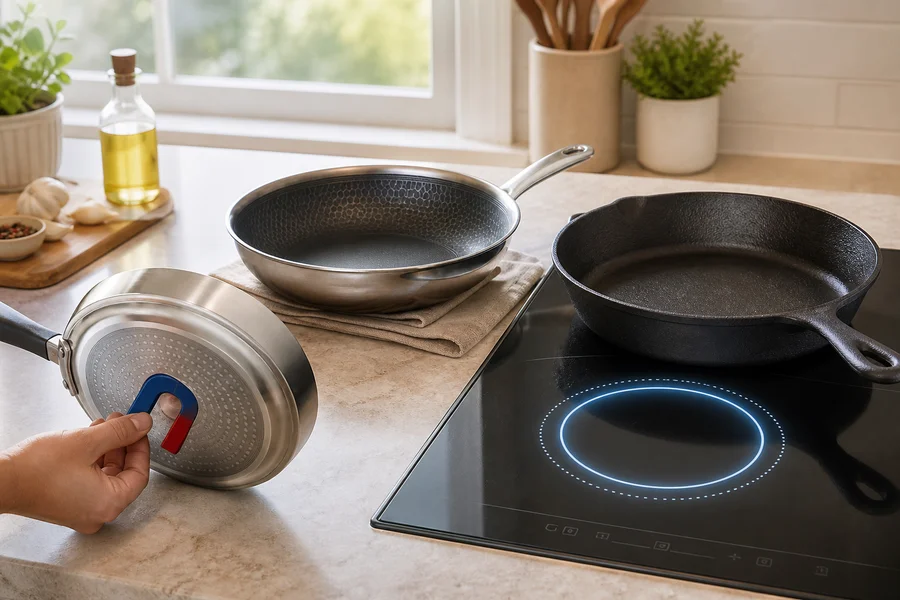
A household magnet is a helpful first screening tool: it should attract firmly to the underside across the area intended to heat. However, magnetism alone does not prove that a pan will heat evenly, work efficiently or suit every hob. Base thickness, layering, flatness and the amount of contact with the zone also influence results.
Inspect the underside where possible. It should be flat and stable, without obvious rocking or pronounced warping. Also check that the induction claim applies to the complete pan, rather than only to a separate insert or limited part of its base.
- Read the product specification for an explicit induction claim.
- Use a magnet as a screening check, not a complete performance test.
- Avoid pans with a visibly uneven or unstable base.
- Compare the flat contact area, not only the stated pan diameter.
 FastDelivery
₹2,879
₹3,845
25%OFF
Materials and Constructions: Heat Response, Coatings, and Maintenance
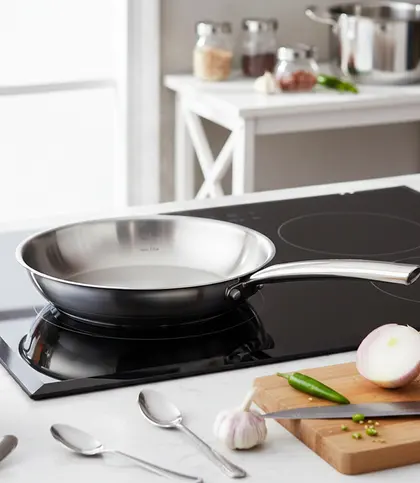
Material is best treated as a set of trade-offs rather than a shortcut to the perfect pan. Stainless steel and layered constructions can suit versatile, durable everyday cooking, but their performance depends on the particular base and layers. Aluminium is naturally non-magnetic, so an aluminium pan needs a suitable magnetic layer or base to work on induction.
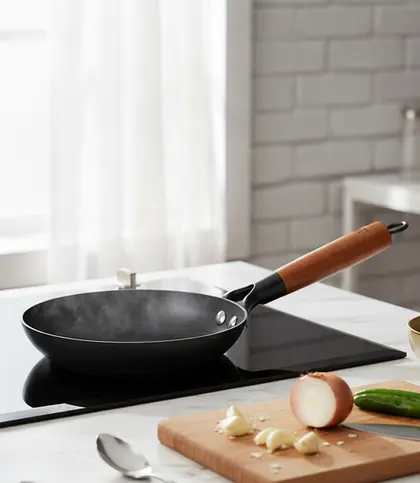
Cast iron is valued by many cooks for heat retention and searing, but it can be heavy to lift, slower to change temperature and more demanding to dry and store. A coated or ceramic-style cooking surface may make food release and washing easier, but it needs to be used within the manufacturer’s utensil, preheating and temperature guidance.
Separate the body material from the cooking surface when comparing pans. A lid can also widen a frying pan’s role for covered cooking, though it adds something to store, wash and handle.
- Layered construction can offer an all-round everyday option when the base is induction-compatible.
- Aluminium requires a confirmed magnetic induction base.
- Cast iron can suit heat-retentive cooking if its weight and care routine work for you.
- Check coating instructions before using high heat, metal utensils or abrasive cleaners.
₹949
₹1,145
17%OFF
Match the Pan Base to the Induction Cooking Zone
Before buying, check your hob manual or measure the intended cooking zone. Compare it with the pan’s actual flat base diameter rather than its rim measurement, since a pan’s cooking surface can be much wider than the area touching the hob.
A very small base on a large zone may heat less evenly and may not be detected by some hobs. Conversely, a pan that extends well beyond the active area can leave the outer edges less responsive. Your hob’s minimum-pan guidance is the most useful reference when you are choosing compact cookware.
If you are considering an unusually small or large pan, it is worth checking the pan and hob together where possible. This simple match matters as much as the pan’s material.
- Use the hob manual to identify the zone diameter and minimum-pan guidance.
- Check the flat base diameter rather than relying on a nominal pan size.
- Avoid assuming every magnetic pan will be detected equally well on every zone.
Choose the Right Size and Depth for Your Cooking
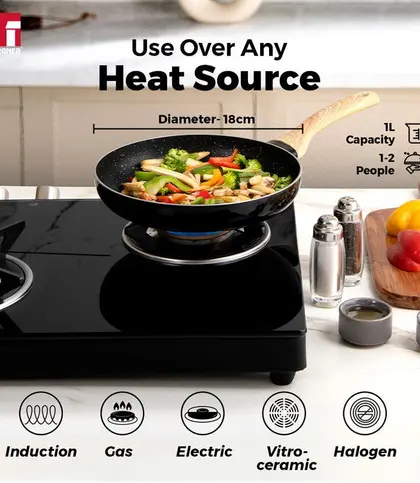
A compact frying pan can be practical for one or two eggs, small portions, reheating and smaller cooking zones, as long as its base meets the hob’s detection requirements. An 8-inch format, for example, can give useful room for smaller everyday portions without taking up the space of a family-sized pan.
Medium and larger formats are useful when you regularly sauté vegetables, cook omelettes, brown several portions or make meals for more people. They need a cooking zone that supports their base and may feel substantially heavier when full.
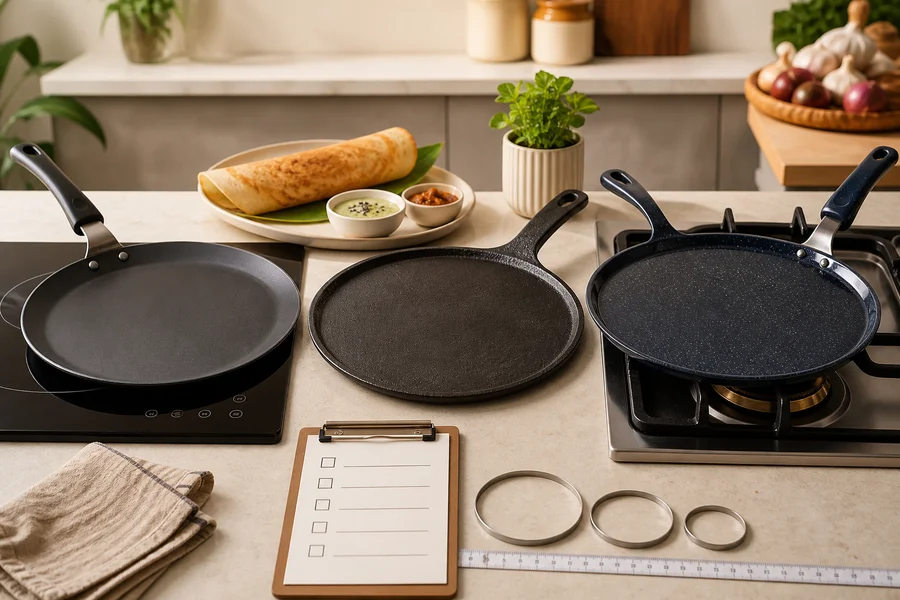
For dosas, focus on a broad usable surface and a handle you can control comfortably. A frying pan and a tawa are designed differently, so choose a frying pan only if its shape and side height suit the way you spread and turn food. Shallow sides aid turning, while deeper sides are useful for containing sautéed ingredients.
- Choose compact cookware for small portions only after checking hob detection requirements.
- Use a medium pan as an everyday compromise for many homes.
- Choose larger pans for searing or family portions when the zone, storage and lifting weight are suitable.
- Consider usable cooking surface and side height, not diameter alone.
 FastDelivery
₹1,499
₹1,875
20%OFF
Weight, Handle Design, Care, Temperature Limits, and Warranty
A heavier pan can feel stable and retain heat well, but heavier is not automatically better. Consider whether you can comfortably lift the empty pan, move it when full, wash it at the sink and store it without strain. Balance matters just as much as total weight.
Check handle length, grip, attachment and heat guidance. The handle should feel secure and allow you to move food without reaching uncomfortably over an active zone. A helper handle, pouring edge or lid may be useful for your routine, but only if the extra bulk suits your storage space.
Read the care instructions before purchase. They may cover seasoning, hand washing, drying, dishwasher use, suitable utensils, stacking and cleaning products. Check temperature limits separately for the pan, cooking surface, handle and lid. Warranty terms should also be read for covered defects, exclusions and the claim process rather than assumed from the material.
- Test whether the pan’s weight and balance suit daily lifting and washing.
- Look for a secure, comfortable handle with clear heat-use guidance.
- Follow coating, seasoning and cleaning instructions from the manufacturer.
- Verify oven, dishwasher and warranty details in the product documentation.
₹2,699
₹3,815
29%OFF
Practical Checklist: Compare Frying Pans by Habit and Budget
Use this checklist to narrow your options quickly. First remove pans that do not clearly state induction compatibility or that have a base unsuitable for your hob. Then choose among the remaining pans by your normal portion sizes, preferred cooking style and willingness to maintain the cookware.
A 10-inch cast-iron format can offer space for searing and larger portions, but it is only a good fit if you are comfortable with the weight and your induction zone supports the base. Compare practical features that matter to your routine, such as a lid, usable surface area and care needs, rather than treating a higher price or heavier build as proof of better performance.
- Compatibility: Is induction use explicitly stated, and does a magnet attract across the base?
- Base: Is it flat, stable and appropriately sized for your cooking zone?
- Cooking style: Are you mainly making eggs, dosas, sautéed dishes, seared food or family portions?
- Construction: Do you prefer responsive cooking, heat retention or an easy-release coated surface?
- Handling: Can you lift the pan comfortably, and does the handle suit your hob and storage?
- Maintenance: Are you prepared to season and dry cast iron, or would lower-maintenance cookware suit you better?
- Budget: Compare practical features, expected care and warranty terms with what you will actually use.
 FastDelivery
₹1,834
₹2,550
28%OFF
Final Verdict: Which Induction Frying Pan Should You Choose?
First eliminate any frying pan that fails the induction, base-flatness or cooking-zone checks. From the suitable options, choose a compact pan for eggs and small portions, a medium pan for flexible everyday cooking, or a larger format when you regularly sear food or cook for several people.
Choose a coated construction when easy release and straightforward cleaning are priorities, subject to its care and heat limits. Choose cast iron when heat retention and searing matter more than light handling and low-maintenance care. Layered construction can be a versatile everyday choice, but its specific base and care details still need checking.
The best frying pan for your induction hob is the one that works reliably with your zone and fits your habits. It is not automatically the largest, heaviest or most expensive option.
- For compact cooking: prioritise detection-compatible base size and easy handling.
- For everyday versatility: balance usable surface area, weight and construction.
- For searing and larger meals: confirm zone fit, storage space and comfortable lifting.
- For every choice: follow the manufacturer’s compatibility and care instructions.
Final Verdict
- Choose compatibility first: the pan needs an explicitly induction-safe, magnetic, flat and stable base.
- Match the flat base diameter to your hob zone before deciding on material or nominal pan size.
- Pick a compact, medium or larger pan according to portion size, cooking style, handling comfort and storage.
- Let maintenance tolerance guide the final material and coating choice: easy-release coated surfaces, layered builds and cast iron each have different care trade-offs.
FAQs
How can I check if a frying pan is compatible with an induction hob?
Check for an explicit induction-compatible statement from the manufacturer. You can also place a magnet against the underside; a firm attraction is a useful screening sign. Still, confirm the product specification and ensure the base is flat and appropriately sized for your hob, because magnetism alone does not guarantee even heating or detection on every zone.
Which materials work best for induction frying pans?
No one material is best for every cook. Layered stainless-steel constructions can suit versatile everyday use, aluminium pans need a confirmed magnetic base, and cast iron can suit heat-retentive searing. The specific base design, weight, care requirements and your cooking habits matter more than the material name alone.
How should a frying pan base match the induction cooking zone?
Compare the hob zone with the pan’s flat base diameter, not only its rim diameter. A base that is much smaller than the zone may heat less evenly or may not be detected by some hobs. A pan extending far beyond the active area may have less responsive edges. Follow the hob manual’s minimum-pan guidance.
What frying pan size is best for eggs and dosas?
A compact pan can suit eggs and small portions if its base meets your hob’s detection requirement. For dosas, prioritise a broad usable surface and a handle that feels easy to control. Check whether a frying pan’s side height and shape suit your technique, since it differs from a tawa.
What frying pan size is best for family meals?
A medium-to-large pan is generally more useful for family portions, sautéing and searing several items at once. Confirm that its flat base is supported by a sufficiently large induction zone, and consider whether you can comfortably lift and store it.
Are heavier frying pans better for induction cooking?
Not necessarily. A heavier pan may offer stability and heat retention, but it can be harder to lift, clean and store, and may respond more slowly to temperature changes. Choose a weight that feels manageable for your everyday cooking.
What coating and care details should I check before buying?
Check recommended utensils, preheating guidance, cleaning instructions, dishwasher guidance and any restrictions on abrasive cleaners or stacking. Also review maximum temperature limits for the pan, coating, handle and lid separately. Follow the manufacturer’s instructions for the specific product.
Can an induction frying pan be used on other hob types?
It may be suitable for other hob types, but induction compatibility alone does not confirm this. Check the manufacturer’s specifications for supported cooktops and follow any surface-specific care guidance.
Keep exploring