


Best Wood for Shelves: How to Choose by Room and Load
Quick Answer
There is no single best wood for every shelf. Choose solid wood or quality plywood for heavier loads and longer unsupported spans; choose MDF for a smooth painted finish in dry rooms with light-to-moderate loads; and reserve particleboard for short, protected, light-duty shelves. In kitchens, bathrooms and utility areas, moisture protection, sealed edges and secure wall fixing are essential.
Definitions
Span
The unsupported distance between brackets, cleats, side panels, or other supporting points.
Sagging
The gradual downward deflection of a shelf under load, often increased by a longer span, greater depth, thinner material, or uneven loading.
Edge banding
A covering applied to an exposed board edge, improving appearance and helping protect porous engineered-board edges from impact and limited moisture.
Moisture-resistant board
A board formulated or finished to tolerate more humidity than standard board; it is not automatically waterproof or suitable for constant water exposure.
Load
The weight placed on a shelf, including both the objects and any containers or hardware resting on it.
Best Wood for Shelves: The Short Answer
For shelves carrying books, files, cookware, tools or other sustained weight, solid wood and quality plywood are usually the most versatile starting points. They are better suited to demanding spans when board thickness, support spacing and wall mounting are also appropriate.
MDF is practical for short shelves in dry rooms where a smooth painted surface matters and the intended load is light to moderate. Treat particleboard as a budget, light-duty option: keep spans modest, protect its surface and edges, and avoid repeated moisture exposure.
For humid rooms, choose a suitable solid wood or a properly sealed moisture-tolerant board. The finish, sealed cut edges and mounting hardware matter as much as the base material.
- Heavy loads or longer spans: favour solid wood or quality plywood.
- Dry, painted display shelves: MDF can be a good fit.
- Short, lightly loaded, protected shelves: particleboard can work.
- Humidity or splashes: prioritise sealing, edge protection and suitable fixings.
Solid Wood, Plywood, MDF, or Particleboard?
Solid wood offers natural grain, the option to refinish or repair small marks, and dependable performance when a suitable species, thickness and support system are chosen. It can cost more than board products and will expand and contract with humidity, so a good finish and sensible installation matter.
Plywood is made from layered veneers and is often a strong, stable panel choice for shelves. It can be painted, veneered, stained where the face grade permits, or left with a visible layered edge. Quality varies, so inspect the face, core and edges rather than assuming every plywood panel performs alike.
MDF is dense, uniform and particularly easy to paint smoothly. Its weight and poor response to unsealed water exposure are important limitations, especially on a long shelf or near a sink. Particleboard is economical and consistent for light-duty applications, but is generally less forgiving of wet edges, damaged screw holes and long unsupported spans.
Compare each material across the actual job: expected weight, span, room conditions, desired finish, maintenance and available support. A material ideal for a small painted display shelf may be unsuitable for a deep book shelf.
- Solid wood: natural finish, repairability and good potential for moderate-to-heavy use with proper support.
- Plywood: a useful strength-to-weight balance and a versatile engineered panel.
- MDF: smooth, uniform and paint-friendly for dry-room use.
- Particleboard: best for protected, short-span and lightly loaded shelving.
How Load, Span, and Thickness Change the Choice
Start with what the shelf must hold. A few framed photographs place very different demands on a board than rows of books, cookware, office files or tools. Heavy loads and longer unsupported spans generally call for solid wood or plywood, a thicker board, closer supports, or a combination of these measures.
Depth also changes the demand. A deeper shelf gives objects more room, but it increases leverage on brackets and can make front-edge loading more demanding. Keeping heavy objects close to the wall-side support can help, but it does not replace correct board and hardware selection.
There is no reliable one-size thickness for every shelf. Material quality, span, depth, intended load, support layout and any front stiffener all affect deflection. Follow shelf or hardware manufacturer guidance where supplied, and reduce the unsupported distance or add support if the use is uncertain.
Do not judge a floating shelf only by its clean appearance. Concealed hardware must be rated for the intended load and fixed into suitable wall structure; decorative fittings cannot compensate for weak anchors or unsuitable walls.
- Longer span means more risk of deflection.
- Greater depth increases leverage at the wall and brackets.
- Thicker boards and closer supports can reduce sagging.
- Wall condition and fixing type may set the safe limit before the shelf board does.
Choose by Room and Use Case
Living rooms and bedrooms often allow the broadest choice because they are usually dry. MDF or particleboard can suit short shelves for light decor when fully finished, while solid wood or plywood is the safer direction for heavier objects, longer runs or a natural wood look.
For a home office or book storage, plan for sustained weight rather than occasional display use. Plywood or solid wood is often more suitable, while MDF can work on shorter spans when additional support is provided. Files can be deceptively heavy, so check shelf and fixing guidance before loading them fully.
In kitchens, choose well-sealed solid wood, suitable plywood or a moisture-tolerant finished board. Protect exposed edges, especially near sinks, kettles and steam. Avoid untreated particleboard in splash-prone locations.
Bathrooms need the most caution. A suitable hardwood or properly sealed board can work where it is not exposed to standing water, but no wood-based board should be assumed waterproof. Seal all cut edges, inspect the finish periodically and use hardware appropriate for humid conditions.
For utility rooms, plywood or solid wood is practical for heavier supplies and tools. Sealed MDF may suit light storage in a dry utility area, while particleboard is best limited to protected, light loads. In every room, match the fixing to masonry, studs, drywall or tile rather than treating shelf material as the only safety decision.
- Display shelves in dry rooms: finish and appearance may lead the decision.
- Books and files: prioritise board stiffness and support spacing.
- Kitchens: use sealed surfaces and protected edges.
- Bathrooms: plan for humidity, not waterproof performance.
- Utility areas: choose support and board strength for heavier practical loads.
Finish, Maintenance, and Budget Trade-offs
Solid wood works well with clear finishes, oils, waxes and stains, depending on the intended look and room. Finish all faces and exposed edges as consistently as practical, particularly where humidity changes are expected. A finish protects the surface, but it does not remove the need for suitable support.
Plywood can be painted, veneered, stained or left with an intentional layered edge. Edge quality varies by panel, so some shelves benefit from banding, solid-wood lipping or careful filling before painting. MDF provides an especially even painted surface after suitable priming, but cut edges need thorough sealing to prevent a rough finish and moisture uptake.
Particleboard normally relies on a complete laminate, veneer, paint system or another protective surface. Its edges need special attention because they are easily chipped and can absorb moisture. Lower initial material cost may also mean more care is needed with finishing and support.
A premium-looking natural wood shelf is not automatically the right choice for every load, and an economical engineered board is not automatically poor. Choose the finish and maintenance level you can realistically sustain in that room.
- Clear or stained finishes suit solid wood and selected plywood faces.
- Painted finishes suit MDF particularly well in dry rooms.
- Plywood, MDF and particleboard benefit from protected exposed edges.
- A protective finish helps with moisture but does not make a board waterproof.
When You Need Sealing, Edge Banding, Brackets, or Extra Supports
Seal exposed faces and, above all, cut edges wherever cleaning moisture, humidity or occasional splashes are possible. Use a finish compatible with the board and follow its application instructions. Edge banding, solid-wood edging or suitable trim can improve both appearance and protection on plywood, MDF and particleboard.
Add brackets, cleats, dividers or a centre support when the span is long, the board is thin, the shelf is deeply loaded or the wall fixing has limited capacity. These measures can be more effective than simply changing material while leaving the span unchanged.
Keep hardware compatible with both the shelf material and the wall. A screw can strip in a weak board edge, and even robust brackets cannot safely carry a heavy load if their anchors are poorly matched to drywall, hollow masonry, tile or another substrate.
Inspect shelves from time to time for downward deflection, loose fittings, chipped edges and swelling. Act early if you see movement or moisture damage, especially in kitchens, bathrooms and utility rooms.
- Seal cut edges before installation where moisture is possible.
- Use edge treatment for vulnerable or visible engineered-board edges.
- Reduce spans with brackets, cleats, dividers or centre supports.
- Check both the wall substrate and the shelf board before choosing fixings.
Practical Material Decision Guide
Start with the intended load, then measure the unsupported span and depth. Books, files, cookware and tools need a more conservative choice than occasional display pieces, while deeper and longer shelves often need a stronger or thicker board and additional support.
Choose solid wood when natural grain, repairability and a premium material feel matter, or when moderate-to-heavy use can be paired with properly planned support. Choose plywood when a stable engineered panel and a useful strength-to-weight balance are the priority. Choose MDF for dry, light-to-moderate-duty shelves with a smooth painted finish, and particleboard for short, protected, light-duty use.
Before buying or installing, confirm dimensions, unsupported span, depth, expected load, board thickness, support spacing, wall type, fixing method, finish and moisture exposure. This checklist is more reliable than choosing by material name alone.
- Natural finish and repairability: consider solid wood.
- Stable panel for more demanding use: consider quality plywood.
- Dry-room painted shelf: consider MDF.
- Protected light-duty shelf: consider particleboard.
- Always verify the support system and wall before loading the shelf.
Catalog Examples by Listed Material
The following catalog examples are included only to show the listed product names and materials. They are not material recommendations, and their names or material labels do not establish load capacity, span limits, moisture suitability or installation performance.
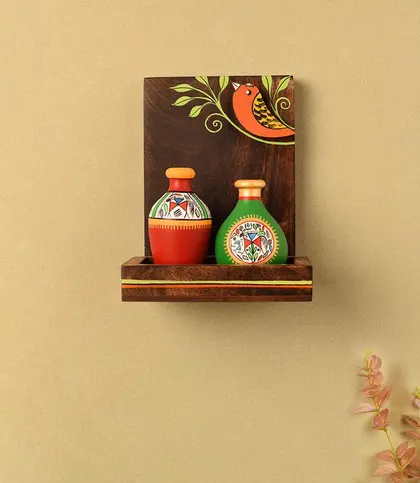
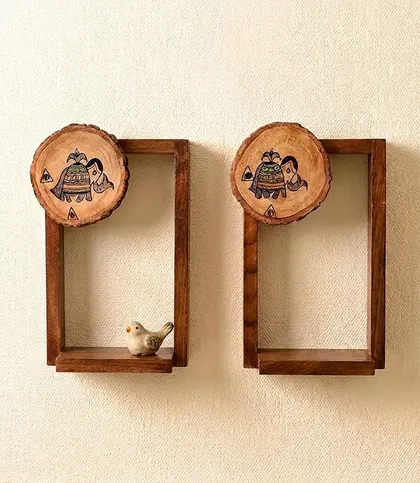
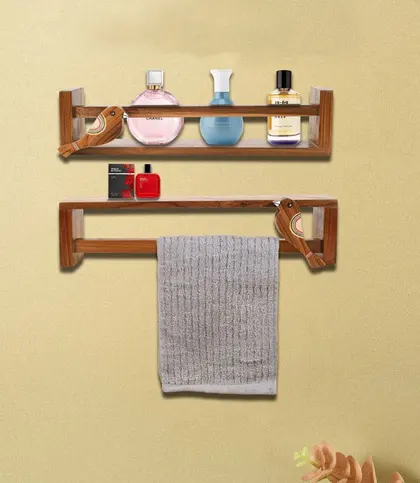
Listed as wood: Shilpa Stupa Wood Shelf; Patang Perch Brass & Wood Shelf; Timber Twist Wall Shelf - Set Of Two; and Teak Wall Shelf - Set Of Two. Listed as MDF: Quadra Block Wall Shelf - Brown; and Skyline Shelving Wall Shelf - Black - Set Of Four.
 FastDelivery
₹749
₹1,019
26%OFF

₹686
₹1,199
43%OFF

₹738
₹1,499
51%OFF
 FastDelivery
₹1,424
₹2,419
41%OFF
 FastDelivery
₹1,472
₹2,459
40%OFF
 FastDelivery
₹2,744
₹4,249
35%OFF
Frequently Asked Questions
Material choice is only one part of a safe shelf. Consider the intended span, depth, load, moisture exposure and fixing method alongside the answers below.
Compare ready-made wall shelves
If you prefer a finished shelf instead of buying raw timber, browse the range below. Check the listed material, dimensions, load guidance, and wall-fixing requirements for your installation.

Final Verdict
- For demanding shelves, begin with solid wood or quality plywood, then confirm thickness, span and support layout.
- For smooth painted shelving in a dry room, MDF is often a practical choice when loads and spans are modest.
- Use particleboard principally for protected, short-span, light-duty shelving.
- Before installation, check load, moisture exposure, edge protection, hardware and wall structure.
FAQs
Which wood is strongest for shelves?
There is no universally strongest choice because species, board quality, thickness, grain direction, span and support all matter. For demanding home shelves, properly selected solid wood and quality plywood are commonly the more versatile choices. Confirm the planned load and installation rather than relying on a material label alone.
Is plywood or MDF better for shelves?
Plywood is usually the better fit for heavier loads, longer spans and situations where a lighter but stable panel is useful. MDF is often better for a very smooth painted finish in a dry room when the shelf is short to moderate in span and lightly to moderately loaded.
What wood is best for bathroom shelves?
Use a suitable solid wood or a properly sealed moisture-tolerant board, with all cut edges sealed and hardware selected for humid conditions. Keep the shelf away from standing water where possible. Neither MDF, particleboard nor solid wood should be assumed waterproof simply because it has been finished.
What wood is best for kitchen shelves?
Well-sealed solid wood, suitable plywood and moisture-tolerant finished boards can all work in kitchens. Choose based on load and location, then protect edges from sink splashes and steam. Untreated particleboard is a poor choice near frequent moisture.
How thick should wood shelves be?
Thickness depends on the material, unsupported span, shelf depth, expected load and support layout. A thicker board can help, but adding brackets, cleats, dividers or a centre support may be equally important. Use manufacturer guidance for the specific shelf and hardware where available.
Which shelf material resists sagging?
Quality plywood and appropriately selected solid wood often suit demanding spans better than MDF or particleboard, but no material is immune to sagging. Shorter spans, adequate thickness, reduced depth and well-spaced supports are decisive for every material.
Is solid wood better than engineered wood for shelves?
Not in every situation. Solid wood is valued for its natural grain and repairability, while plywood can offer stable, efficient shelf performance and MDF is excellent for smooth paint. The better choice depends on the room, load, span, finish and maintenance needs.