


Best Citronella Candles: How to Choose for Outdoor Use
Quick Answer
The best citronella candle is the one that suits your outdoor setting and can be used safely under supervision. For most balconies and patios, a stable jar candle is the most practical choice. Compare the vessel, wax, wick, scent strength, size, and stated burn time, and treat citronella as an ambience feature with limited, variable mosquito-deterrence value rather than guaranteed protection.
Definitions
Citronella candle
A scented candle formulated with citronella fragrance or citronella oil. It can add outdoor ambience and may help discourage some mosquitoes nearby, but results vary and it is not a guaranteed insect-control method.
Jar candle
A candle poured into a glass or metal container that contains melted wax and offers a stable format for tabletop use.
Pillar candle
A freestanding candle that burns without a container and needs a stable, heat-resistant surface with careful supervision.
Stated burn time
The manufacturer's estimated total burning duration under typical conditions. Actual results can vary with wick care, drafts, wax, vessel, and use.
Flameless alternative
A battery-powered candle or other non-flame light source that creates ambience without an exposed flame, though it does not provide the same fragrance or potential citronella effect.
Best citronella candles: choose by setting first
The best citronella candle is not necessarily the largest or most strongly scented option. It is the one that fits the location, the available surface, wind conditions, the atmosphere you want to create, and the level of supervision you can provide.
For everyday outdoor home use, a stable jar candle is often the simplest format to compare and manage. Its contained design can suit a dining table, balcony table, or patio seating area, provided it is placed on a clear, heat-resistant surface.
Think of citronella primarily as a fragrance and ambience choice. Any mosquito-deterrence effect can be limited and variable, so it should not be treated as a guaranteed way to keep mosquitoes away or prevent bites. Compare format, wax, wick, vessel, size, scent, stated burn time, and safety guidance before choosing.
- Start with the intended location rather than the fragrance alone.
- Choose a format that stays stable in the available space.
- Check whether wind, nearby fabrics, children, pets, or foot traffic make an open flame unsuitable.
What citronella candles can and cannot do
Citronella candles can bring a fresh, herbal scent and a warm pool of light to outdoor dining, balcony seating, patio gatherings, and garden evenings. They work best as one part of the setting rather than as the sole solution to an outdoor comfort concern.
Their possible mosquito-deterrence effect depends on the formulation, airflow, placement, number of candles, and local conditions. A breeze can disperse fragrance quickly, while a large open garden may make a single candle feel less noticeable than it would on a small table.
A citronella candle does not guarantee that mosquitoes will stay away, prevent bites, control disease, or protect an entire balcony, terrace, patio, or garden. Do not translate a product claim into a fixed coverage area or a promised result.
- Use candles for fragrance, light, and a considered outdoor mood.
- Treat any deterrence benefit as variable rather than assured.
- Choose other appropriate measures where insect control is a priority.
How to compare wax, wick, vessel, size, scent, and burn time
Read the label as a whole instead of relying on one feature. Wax composition, wick design, vessel shape, and intended use work together to affect the candle experience. A higher price or stronger fragrance does not establish stronger mosquito performance.
For wax, compare the stated composition, finish, scent throw, and your preferred use case. Soy and paraffin wax can both appear in scented candles, and neither is universally the best choice. The Nithya Lemongrass Scented Jar Candle is a useful comparison point for readers considering a lemongrass-style fragrance in a paraffin-wax jar format, rather than assuming every fresh citrus-herbal candle has the same composition or effect.
A well-sized wick helps a candle burn more evenly when used according to its instructions. Follow the label’s trimming guidance, as wick condition can affect flame stability, soot, and wax pooling. Inspect any glass or metal vessel for cracks, chips, dents, looseness, or an unstable base before lighting it.
Small candles can suit brief, close-range ambience. Medium candles are often easier to place around a table or seating area. Larger options may offer longer use, but they also need more clear space and attentive supervision. Compare the manufacturer’s stated burn-time estimate rather than candle weight alone, since drafts, wick care, and repeated short burns can alter actual use.
- Wax: compare the stated material, finish, scent performance, and intended use.
- Wick: follow trimming and maximum-burn guidance on the label.
- Vessel: choose an intact, stable, heat-resistant container.
- Size: match it to the surface, gathering duration, and supervision available.
- Scent: decide whether sharp citronella or a softer lemongrass blend feels comfortable.
- Burn time: use the manufacturer's estimate as a guide, not a guarantee.
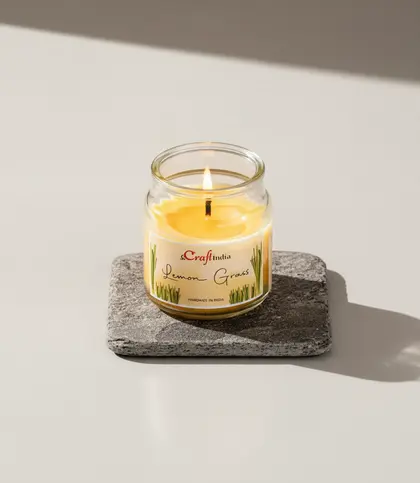
₹149
₹349
57%OFF
Which format suits a balcony, patio, terrace, garden, or indoor space?
A compact jar candle is usually the practical starting point for a balcony. Place it on a clear, level, heat-resistant table or stand, well away from railings, curtains, cushions, and the edge of the surface. Balconies can be windy, so only use a candle when the flame remains stable and the product instructions allow the conditions.
For a patio, a medium jar candle can suit a dining table or nearby seating surface. A pillar can add more decorative presence, but only on a secure, heat-resistant holder or surface that is clear of cloth, paper, and loose décor.
On a terrace, account for wind and foot traffic. Choose a vessel that is difficult to tip, keep it away from edges, and avoid placing it where guests may brush past it. In a garden, set a candle only on a firm, level, nonflammable surface away from dry leaves, grass, branches, and fabrics. A candle should not be viewed as a whole-garden solution.
For a living room or another indoor space, do not assume that an outdoor-labelled candle is suitable. Citronella fragrance may not be comfortable indoors, and ventilation matters. Follow the product label exactly; if indoor use is not clearly directed, choose another lighting option.
- Balcony: compact, stable jar on a clear tabletop or stand.
- Patio: medium jar for dining or seating; use pillars only with secure placement.
- Terrace: prioritise wind resistance, clear walkways, and distance from edges.
- Garden: use a level, heat-resistant surface well away from dry plant matter.
- Indoor room: follow the label and consider whether fragrance and ventilation are suitable.
Placement, ventilation, fire, child, and pet safety
Before lighting a candle, clear the area around it. Place it on a level, heat-resistant, nonflammable surface where it cannot be knocked over. Keep it away from curtains, tablecloths, paper, furniture edges, dry foliage, railings, and any other combustible material.
Never leave a burning candle unattended. Extinguish it before leaving the area, going to sleep, or whenever supervision is interrupted. Keep children and pets away from the flame, melted wax, heated vessel, and any unstable decorative items around it.
Use outdoor candles only as directed and maintain suitable ventilation. Do not use a candle in a sealed or poorly ventilated space. Shield an outdoor flame from strong drafts only if doing so does not enclose the candle, trap heat, or create unsafe airflow.
Stop using the candle if its vessel cracks, becomes excessively hot, the flame is unstable, or the wick produces heavy soot. Follow the manufacturer's directions for the first burn, wick trimming, maximum burn duration, extinguishing, and reuse.
- Keep an open, uncluttered zone around the candle.
- Do not leave a lit candle unattended.
- Separate candles from children, pets, fabrics, and dry plants.
- Avoid strong wind and poorly ventilated spaces.
- Discontinue use if the vessel or flame appears unsafe.
When a non-flame alternative is more suitable
Flameless lighting is the better choice when children or pets may approach the area, when supervision is difficult, or when building rules restrict open flames. It can also make more sense on enclosed balconies, busy walkways, shared housing areas, or for overnight ambience.
A battery-powered candle, lantern, or other non-flame light can provide a warm visual effect without a live flame, hot wax, or heated vessel. This can be especially useful where curtains, cushions, dry plants, or frequent movement make placement difficult.
The trade-off is straightforward: flameless lighting usually does not provide the fragrance of a burning citronella candle or any potential citronella effect. For fragrance-sensitive households, an unscented lighting option may be more comfortable than assuming citronella will suit everyone.
- Choose flameless lighting when continuous supervision is not realistic.
- Use it where open flames are restricted or space is busy.
- Prefer unscented options when fragrance sensitivity is a concern.
Citronella candle selection checklist
Use this checklist before buying or lighting a citronella candle. It keeps the decision focused on the setting, the product label, and practical safety rather than promises of wide-area mosquito protection.
- Where will it be used: balcony, patio, terrace, garden, or indoors?
- Is the area open and ventilated enough for the product label?
- Would a stable jar be safer than a freestanding pillar?
- What wax and wick information does the label provide?
- Is the vessel intact, balanced, and suitable for a heat-resistant surface?
- Is the fragrance strength comfortable for the people using the space?
- What is the stated burn time, and does it fit the planned occasion?
- Can the candle stay visible and supervised for its entire use?
- Are children, pets, fabrics, dry foliage, and wind hazards safely separated?
- Would flameless lighting better fit the setting?
- Does the product make realistic, non-guaranteed claims about mosquito deterrence?
Final recommendation: match the candle to the setting, not the promise
For most outdoor home settings, prioritise a stable jar, clear safety instructions, a comfortable scent, and a stated burn time that fits the occasion. This approach is generally more useful than choosing by size, fragrance intensity, or an assumed mosquito-control benefit.
Choose a pillar when decorative impact matters and you have an especially stable, clear, heat-resistant surface. Reserve tealights and votives for short periods of close, continuous supervision. In every format, treat citronella as an optional scent and ambience feature with uncertain, limited deterrence.
Select flameless lighting whenever flame safety, smoke, fragrance, ventilation, wind, children, pets, or unattended use outweigh the benefits of a burning candle.
- For balconies and patios, a stable jar is often the most practical format.
- For decorative displays, use pillars only with secure placement and close supervision.
- For higher-risk settings, choose flameless ambience instead.
Final Verdict
- Choose a citronella candle when you want outdoor fragrance and ambience, have a stable heat-resistant surface, and can supervise it continuously.
- For general balcony, patio, or terrace use, a jar candle is usually the most practical contained format.
- Compare wax, wick, vessel, scent, size, and stated burn time from the label; do not assume price or fragrance strength guarantees performance.
- Use flameless lighting when an open flame, smoke, fragrance, wind, limited ventilation, children, pets, or unattended use creates a greater safety concern.
FAQs
Do citronella candles really repel mosquitoes?
Citronella candles may help discourage some mosquitoes nearby, but results vary with formulation, airflow, placement, candle count, and local conditions. They do not guarantee bite prevention or mosquito-free outdoor space.
Are citronella candles safe to use indoors?
Do not assume an outdoor-labelled citronella candle is suitable indoors. Follow the product label, ensure appropriate ventilation, and consider whether the fragrance is comfortable for the people sharing the space.
Which wax is best for a citronella candle?
No wax is universally best. Compare the product's stated wax composition, finish, scent performance, price, and intended use. Soy and paraffin wax can both be used in scented candles.
How long do citronella candles usually burn?
Use the manufacturer's stated burn-time estimate for the specific candle. Actual burn time can change with drafts, wick trimming, vessel design, wax, and whether the candle is repeatedly burned for short periods.
Where should I place a citronella candle outdoors?
Place it on a level, heat-resistant, nonflammable surface away from table edges, fabrics, dry foliage, railings, and busy walkways. Keep it visible, protect it from strong wind, and never leave it unattended.
Are citronella candles safe around children and pets?
A burning candle requires separation and continuous adult supervision around children and pets. Keep them away from the flame, melted wax, hot vessel, and unstable décor. Choose flameless lighting if that separation cannot be maintained.
Can citronella candles be used on a balcony?
A compact jar candle can work on a balcony if it is used according to the label on a clear, stable, heat-resistant surface. Check wind, curtains, railings, nearby cushions, ventilation, and building rules before lighting it.
When should I choose a flameless alternative?
Choose flameless lighting when open flames are restricted, the space is enclosed or busy, children or pets may approach, the candle cannot be supervised, or nearby fabrics and dry plants create avoidable risk.