


Wok on Induction Stove: Compatibility & Usage Guide
Quick Answer
Yes, a wok can work on an induction stove when it has a magnetic, flat, stable base that is large enough for the cooking zone to detect. A traditional round-bottom wok should generally not be used directly on a flat induction cooktop.
Definitions
Induction cooking
A cooking method in which the cooktop creates a magnetic field that heats compatible cookware directly.
Magnetic compatibility
The ability of a wok’s base to respond to the cooktop’s magnetic field. Suitable cast iron and magnetic stainless-steel constructions generally respond.
Flat-bottom wok
A wok with a level, continuous contact area designed to sit directly on a flat cooktop.
Round-bottom wok
A wok with a curved base intended for a support ring or burner shape; it usually cannot sit securely or maintain sufficient contact on a flat induction hob.
Triply construction
A layered cookware construction, commonly involving stainless steel and an aluminium core. Induction suitability depends on whether the finished base includes a magnetic layer and is approved by the maker.
Can You Use a Wok on an Induction Stove?
Yes—provided the wok passes three practical checks: its cooking base is magnetic, it sits flat and steady on the glass, and its contact area suits your cooktop’s vessel-size guidance. These factors matter more than the wok’s overall shape or appearance.
A magnet sticking to the underside is a useful first sign, but it is not a complete answer. The base also needs to be level enough for reliable detection and stable enough for safe stirring. Round-bottom woks generally should not be placed directly on a flat induction cooktop.
- Use a wok with a magnetic, flat, stable base.
- Check the appliance manual for minimum and maximum vessel-size guidance.
- Treat a magnet test as a screening check, then confirm performance on the hob.
How Induction Cooking Works with a Wok
An induction hob uses a magnetic field to heat compatible cookware rather than heating the glass surface in the same way as a conventional electric burner. That is why the cookware base must contain material that responds to the field.
For dependable cooking, enough of the wok’s magnetic base must overlap the active zone. A wok may have broad curved sides, but the strongest induction response is concentrated around the base. This can make the lower centre hotter than the sides, especially with a small contact area.
- Centre the wok over the marked cooking zone.
- Match the base size to the zone recommendations where possible.
- Stir and move food through the hotter base area when cooking small batches.
How to Check Whether Your Wok Works on Induction
Start by holding a household magnet against the exterior underside of the wok. Firm attraction is a positive sign; no attraction usually means the wok will not work directly on induction. However, a magnetic patch that is very small or highly curved may still be difficult for a hob to detect.
Next, place the wok on a cool, switched-off cooktop. It should sit level without rocking. Inspect the underside for warping, a pronounced central bulge, residue, or damage that could affect contact. Finally, check the product markings or maker’s instructions for induction approval and base-diameter requirements.
Test an apparently suitable wok with a small amount of water on moderate power while you stay nearby. Stop if the hob shows an error, the vessel rocks, or heating is clearly irregular.
- Check for firm magnetic attraction on the cooking base.
- Confirm that the base is clean, dry, smooth, and level.
- Read both the wok and induction-hob instructions before regular use.
- Use a brief water test rather than an empty high-heat test.
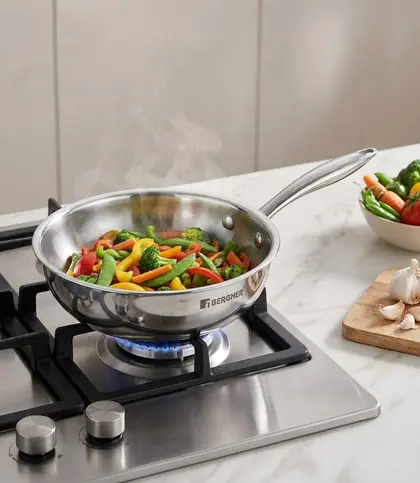
₹1,544
₹1,930
20%OFF
Choosing a Wok Material and Base for Induction
Material alone does not decide compatibility. Suitable cast iron and magnetic stainless-steel constructions can work well on induction, but only when the base is flat, stable, and correctly sized for the hob. Not every stainless-steel or triply wok has a magnetic induction-ready base, so always confirm the specific product’s labelling.
A wide, level contact base improves stability and can help the hob recognise the wok. It should not, however, be so small that it falls below your appliance’s detection threshold. Alongside compatibility, consider a comfortable handle, secure handle fittings, capacity, and the care needs of an enamelled, coated, or layered finish.
- Choose explicitly labelled induction-compatible cookware when buying new.
- Verify triply construction rather than assuming all triply woks work on induction.
- Consider a compact capacity for smaller portions and a larger capacity for regular family cooking.
- Check the care guidance for enamelled or coated finishes before using high power.
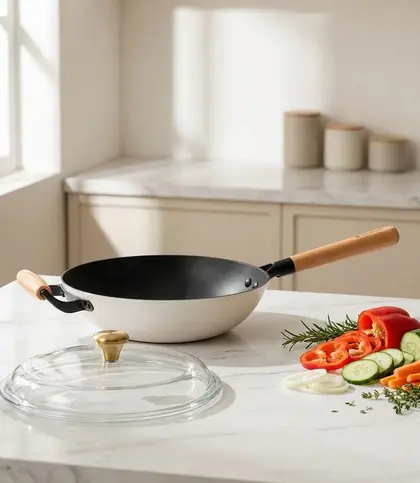
₹3,959
₹6,639
40%OFF

₹5,249
₹6,560
20%OFF
Flat-Bottom vs Round-Bottom Woks on an Induction Stove
A flat-bottom wok is the practical choice for a flat induction cooktop. It remains steady, gives the hob a continuous contact area, and is easier to use safely when you are stirring or adding ingredients.
A traditional round-bottom wok usually rocks on the glass, leaves an air gap below its base, and may not be detected or heat evenly. Do not try to balance one directly on the cooktop. A purpose-designed, manufacturer-approved support or interface may be appropriate in some cases, but it is not equivalent to using a flat induction wok.
If considering an adapter disc, follow both the disc and appliance instructions. Such accessories can alter heat response, reduce efficiency, and introduce stability considerations.
- Prefer a flat-bottom wok for direct use on a glass induction surface.
- Do not balance a round-bottom wok on the cooktop.
- Use an interface solution only when it is explicitly suitable for the wok and hob.
Preheating and Heat Control When Using a Wok on Induction
Induction reacts quickly, so begin at a moderate power level instead of immediately selecting maximum heat. This is especially important with a lightweight wok, a small base, or a layered and enamelled construction. Preheat briefly, then add oil and ingredients promptly rather than leaving an empty wok on high power.
Cook in manageable quantities. Overloading a wok can cool its base quickly and cause food to release moisture and steam instead of stir-frying. Make small power adjustments early, rather than repeatedly switching from low to maximum heat.
Follow the heat limits supplied by the cookware and cooktop makers. The appropriate setting and preheating time vary with the induction zone, wok size, base construction, and amount of food.
- Start at moderate power and increase only if needed.
- Avoid heating an empty wok at high power.
- Add food in batches when necessary to avoid crowding.
- Reduce power early when oil begins to shimmer or food starts browning quickly.

₹2,699
₹3,355
20%OFF
Troubleshooting Detection, Stability, and Uneven Heating
If the hob does not detect the wok, centre it on the zone and make sure the base is clean and dry. Recheck that the base is magnetic and that its contact area meets the appliance’s minimum vessel-size requirement. A magnet can stick to a wok that still has too little magnetic area for reliable detection.
If the wok rocks, stop using it directly. Warping, a curved base, or a damaged underside can make stirring unsafe and worsen heating performance. If heat seems concentrated at the centre, reduce the quantity of food, stir regularly, and consider whether the base is too small for the selected zone.
Try another compatible pan on the same cooking zone. If that vessel also fails, consult the appliance manual or its support guidance rather than assuming the wok is the only issue.
- Centre the wok and dry its underside before testing.
- Do not continue using a wok that rocks on the glass.
- Use a different compatible vessel to help identify a cooktop issue.
- Check the manual when error messages continue.
Cleaning the Wok and Protecting the Induction Cooktop
Allow the wok and cooktop to cool in line with their care instructions before cleaning. Avoid sudden temperature changes, such as placing a hot wok under cold water, as thermal shock can affect cookware and finishes.
Lift the wok instead of dragging it across the glass. Grit, baked-on residue, rough cast-iron surfaces, chips, or burrs on the underside can mark the cooktop when moved sideways. Wipe the hob with a soft cloth or non-abrasive sponge and use the cleaning method recommended for your appliance.
Clean the wok according to its material and finish, then dry the base completely before returning it to the hob or cupboard. Inspect the underside periodically for trapped food, damage, or rough spots.
- Lift cookware on and off the induction surface.
- Keep both the glass and wok base free of grit.
- Avoid abrasive powders and harsh tools unless the appliance maker permits them.
- Dry the wok base thoroughly after washing.
Quick Decision Checklist: Use, Adapt, or Replace Your Wok
Use your current wok when it has a magnetic base, sits flat without rocking, is detected consistently, and fits within the cooktop’s vessel-size guidance. In that case, moderate preheating and responsive power adjustments will usually give the best control.
Adapt cautiously only when the wok and appliance makers permit an appropriate interface solution and the setup remains stable. Replace the wok if it is non-magnetic, round-bottomed, warped, damaged, unstable, or repeatedly undetected despite correct placement.
For a new wok, prioritise clear induction-compatible labelling, a flat magnetic base, secure handles, and capacity that fits how you cook. A medium-capacity wok can suit everyday meals, while a larger model may be more useful when preparing bigger portions.
- Use: magnetic, flat, stable, correctly sized, and reliably detected.
- Adapt cautiously: only with an approved solution and stable setup.
- Replace: non-magnetic, round-bottomed, warped, damaged, or repeatedly undetected.
- Buy thoughtfully: match the base and capacity to your hob and household needs.
Compare wok options carefully
The range below includes different bases and materials. Only choose a model whose listing explicitly confirms induction compatibility and a base size suitable for your hob.

Final Verdict
- A wok can generally be used on an induction stove when it clears three gates: a magnetic response, a flat and stable contact base, and reliable detection within the hob’s size guidance.
- A magnet test is helpful but not conclusive. Confirm the wok sits securely and perform a supervised moderate-power water test before regular cooking.
- Choose a flat-bottom, explicitly induction-compatible wok for the simplest and safest experience. Do not use a traditional round-bottom wok directly on a flat glass induction surface.
FAQs
How can I tell if my wok works on an induction stove?
Hold a magnet to the exterior underside of the wok. Firm attraction is a positive first sign, but also check that the base is flat, stable, and large enough for your hob to detect. Confirm the maker’s induction guidance and test with a small amount of water on moderate power.
Which wok materials are compatible with induction cooktops?
Suitable cast iron and magnetic stainless-steel constructions can be compatible. Some triply woks also work, but not all stainless steel or layered cookware is magnetic, so check the specific product’s induction label or instructions.
Does a round-bottom wok work on a flat induction stove?
A round-bottom wok generally should not be used directly on a flat induction cooktop because it may rock, leave an air gap, and fail detection or heat unevenly. Use a flat-bottom wok unless a manufacturer-approved alternative is specified.
What type of wok base is best for induction cooking?
A flat, smooth, magnetic base that sits securely on the cooktop and meets the zone’s vessel-size guidance is best. The wok should not rock or have severe warping, a pronounced bulge, or a very small magnetic contact patch.
Why does my induction stove not detect my wok?
The base may be non-magnetic, too small, too curved, not centred, or dirty or wet. Check the wok against the appliance’s minimum base-size guidance, then test another compatible pan on the same zone to help identify whether the issue is the wok or the hob.
How should I control heat when using a wok on induction?
Start at moderate power, preheat briefly, and add oil and food promptly. Make small adjustments early because induction responds fast. Avoid leaving an empty wok on high power and cook in batches when a large load would crowd the base.
Can a wok scratch an induction cooktop?
It can, particularly if you drag cookware with grit, residue, a rough underside, chips, or burrs across the glass. Lift the wok to move it, keep the base clean, and inspect it regularly for damage.
How do I clean a wok after using it on induction?
Let the wok cool according to its care guidance, then clean it using the method appropriate to its material and finish. Dry the underside completely. Wipe the cooled induction surface with a soft, non-abrasive cloth or sponge following the appliance maker’s instructions.