

Quick answer
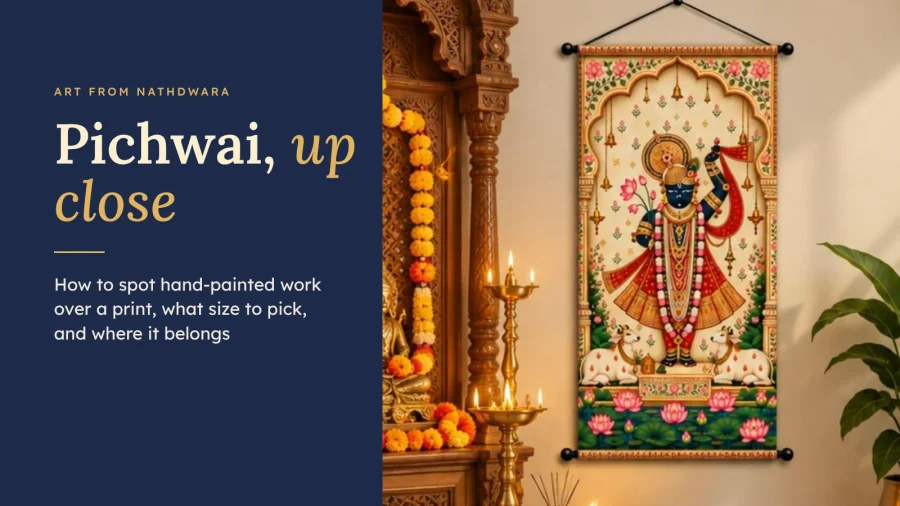
A Pichwai is a devotional painting from Nathdwara in Rajasthan, made to hang behind the idol of Shrinathji, the child form of Krishna. A hand-painted Pichwai shows brushwork, raised layers of paint and small irregularities; a print has a flat, even surface. Both can look beautiful at home. Choose a good canvas print with fine detail for a feature wall, or commission hand-painted work if you want an heirloom. For a living room, choose a large Pichwai about two-thirds the width of your sofa; for an entrance or pooja room, a medium or small one works better.
What is a Pichwai painting?
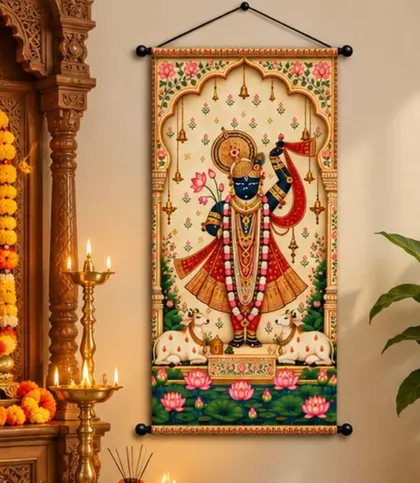
The name comes from pichh (back) and wai (hanging): a cloth painting hung behind the deity in the Shrinathji temple at Nathdwara. Traditional Pichwais show Shrinathji with gopis and cows, lotus ponds, and scenes from festivals and seasons. Deep blues, greens, reds and gold are typical, with dense, detailed borders.
Common Pichwai motifs and what they mean
Shrinathji
- What it shows: The child Krishna lifting Govardhan hill
- Suits: Pooja rooms, living room feature walls
Cows (Kamdhenu)
- What it shows: Krishna's cows, a symbol of plenty
- Suits: Living rooms, entrances
Lotus ponds
- What it shows: Lotuses in moonlight or at dawn
- Suits: Calm living rooms and bedrooms
Garden pavilions
- What it shows: Krishna's gardens and festivities
- Suits: Dining areas and hallways
How to tell an authentic hand-painted Pichwai from a print
- Look at the surface from the side. Hand-painted work has slight ridges where paint layers build up; a print is completely flat.
- Check fine details. In hand-painted work, borders, jewellery and lotus petals show tiny variations. A print repeats them exactly.
- Zoom in. A printed image shows an even dot pattern or soft pixel edges up close.
- Read the listing. Sellers usually state "hand-painted" or "print" and the base, such as canvas, paper or cloth.
- Consider time and price. Hand-painted Pichwais take artists weeks, so they cost far more than prints.
Choosing a Pichwai print that doesn't look cheap
A good print can still look rich on the wall. Look for:
- Canvas over glossy paper, for texture and less glare from windows and tubelights.
- Sharp detail at full size, with no blurring in borders, faces or the cows' markings. Zoom into close-up product photos before you order.
- A simple frame, in gold, wood or black, so the painting's colours lead.
- Large sizes for feature walls, where the detail can be seen from across the room. A canvas framed at least 3.5 cm deep also looks more substantial from the side.
Pichwai art at Vaaree
Our Pichwai collection features printed art inspired by the Nathdwara tradition, in sizes from a small accent to a statement piece.
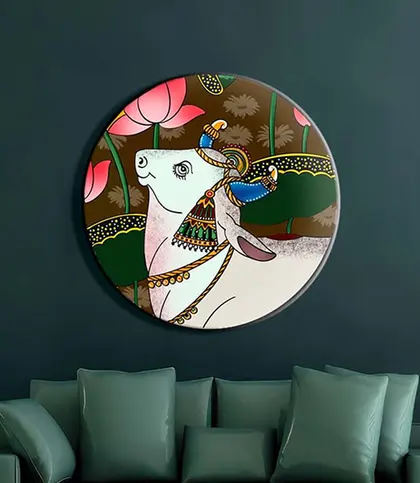
For a living room feature wall: the Kaamdhenu Pichwai Canvas Wall Painting, framed and available up to XL. For a bedroom or reading corner, the Moonlit Lotus Pond Pichwai Canvas Wall Painting comes in calm blues.
From ₹2,328
₹3,100
23%OFF
From ₹1,699
₹2,599
35%OFF
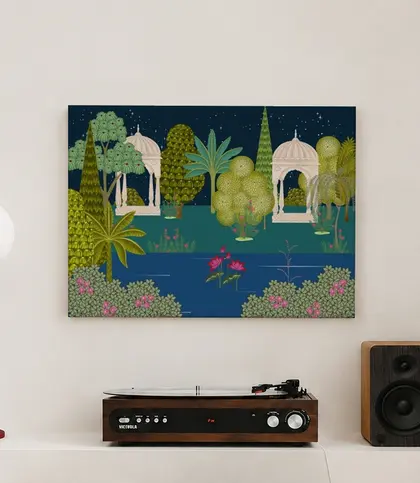
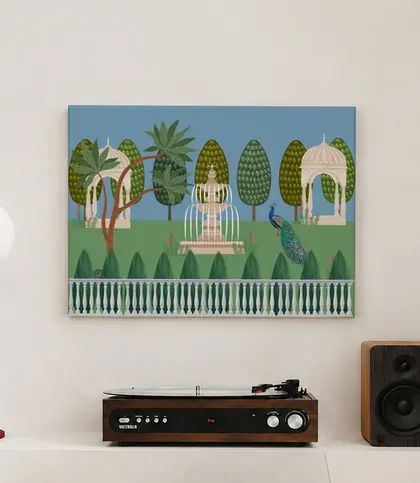
For a console, hallway or pooja room: the Garden Pavilion Pichwai Canvas Wall Painting in its small size, or the Shrinathji Pichwai Canvas Wall Tapestry, listed at 46 x 86 cm (about 18 x 34 inches), for the wall behind the idols.
From ₹1,699
₹2,599
35%OFF
₹799
₹1,299
38%OFF
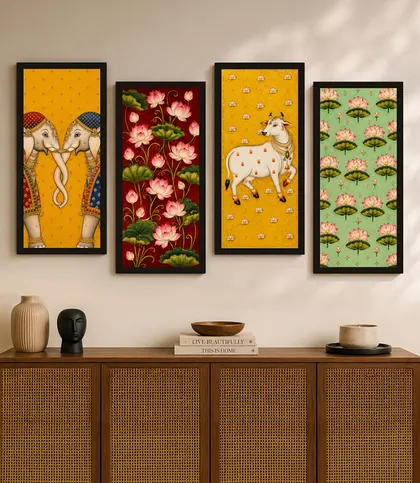
For a gallery-style arrangement: the Traditional Floral Pichwai Paper Wall Painting With Frame, set of four.
₹999
₹3,000
67%OFF
For more, browse our wall art and paintings.
Wall Art & Paintings

₹1,726
₹4,000
57%OFF
 FastDelivery
₹2,199
₹6,000
63%OFF
From ₹1,709
₹1,799
5%OFF
 FastDelivery
₹1,599
₹6,000
73%OFF
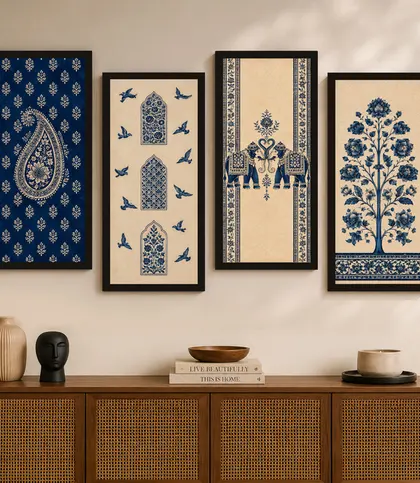 FastDelivery
₹999
₹3,000
67%OFF
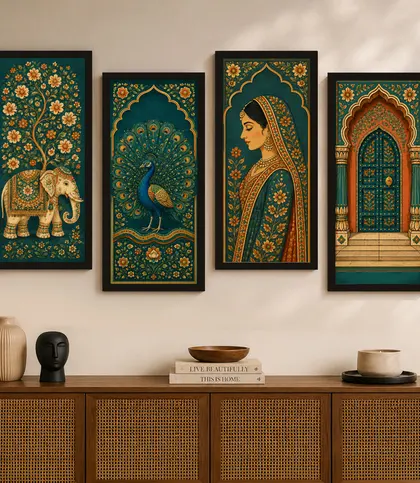 FastDelivery
₹999
₹3,000
67%OFF
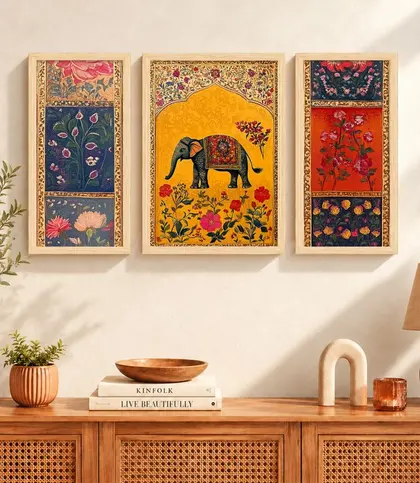 FastDelivery
₹825
₹2,500
67%OFF
From ₹1,799
Where to hang a Pichwai at home
- Living room feature wall: a large Pichwai above the sofa anchors a traditional or modern Indian room; aim for about two-thirds of the sofa's width (around 135 x 90 cm above a 3-seater), with the bottom edge 15 to 25 cm above the backrest.
- Pooja room: A Shrinathji Pichwai suits the wall behind the idols, as in the temple tradition. A small size, about 45 x 60 cm, sits neatly behind or just above the idols.
- Entrance: A cow or lotus Pichwai welcomes guests. Above a console, choose a medium portrait piece, about 60 x 90 cm, narrower than the console, with its centre about 145 to 150 cm from the floor.
- Dining area: garden and festival scenes bring colour to a plain wall. Centre the painting on the table rather than the wall, with its bottom edge 25 to 30 cm above any sideboard.
Many families place Krishna and Shrinathji art on the east or north-east wall, in line with vastu guidance. Keep Pichwais out of direct sun, which fades the deep blues and greens over time.
What size Pichwai do you need?
Measure the furniture below the wall, not the wall itself, then aim for a Pichwai about two-thirds of its width:
- 2-seater sofa (140 to 160 cm): a Pichwai 90 to 110 cm wide.
- 3-seater sofa (180 to 210 cm): 120 to 150 cm wide.
- Console table (90 to 120 cm): 60 to 80 cm wide.
- King bed (180 to 200 cm): 120 to 135 cm wide.
- Bare 10 ft wall with no furniture: 150 to 200 cm, or a set of two or three.
Before you order, cut newspaper to the painting’s size and tape it to the wall for a day. It’s the quickest way to see whether the size feels right from the sofa and from the door. If two sizes both seem to fit, choose the larger one: art almost always looks smaller once it's on the wall, especially in rooms with high ceilings.
Which Pichwai suits your walls and furniture?
- Beige walls and teak or walnut furniture: a deep blue or green Pichwai gives the contrast beige walls need, and a gold frame picks up the warmth of the wood.
- White or light grey walls: almost any Pichwai works; one with plenty of white cows or lotuses keeps it from feeling heavy.
- Muted green or blue walls: pink lotuses and gold details stand out without clashing.
- Patterned wallpaper: move the Pichwai to a plain wall, because two busy surfaces compete.
Canvas or paper: which lasts in humid cities?
In Mumbai, Chennai or Kolkata, canvas is the safer choice. Paper prints are lighter and cost less, but need a glass-fronted frame with a sealed back, and can still ripple in the monsoon. Whichever you choose, avoid walls with seepage, keep the painting away from bathrooms and kitchens, and add small rubber bumpers to the bottom corners of the frame so air can move behind it.
How to hang a Pichwai safely
- Weigh it first. Large framed canvases are heavy, so on concrete or brick walls use a wall plug and screw rated for the weight.
- Use two hooks for wide pieces, so a large Pichwai stays level.
- Use adhesive strips only for small, light pieces, such as a paper Pichwai, and check the weight limit on the pack.
- Check it’s level with a phone spirit-level app before you mark the final hole. Hang the painting first with one person holding it in place and another checking from across the room, so the height feels right from where you usually sit.
Styling a Pichwai in a modern home
Let the Pichwai be the one busy element on the wall. Pair it with plain walls in white, beige or a muted green, a wooden or cane console, and brass accents such as an urli or diyas. Add warm light from a table or floor lamp in the evening to bring out the gold, and leave at least 30 cm of clear wall on each side. Avoid patterned wallpaper behind it.
Is a Pichwai a good wedding or housewarming gift?
Yes. It suits most Indian homes, carries a devotional meaning, and works in both traditional and modern rooms. If you’re unsure of the family’s preferences, choose a lotus or cow scene, which feels calm and auspicious without being strictly religious. A medium size is the safest choice, because it fits almost any wall. Add a short handwritten note on the motif and what it stands for, so the family knows the story behind the painting.
FAQs
Is a printed Pichwai a good choice? Yes, if it is printed on canvas with sharp detail. It offers the look of the tradition at a fraction of the price of hand-painted work.
Where can I buy a Pichwai painting online in India? Explore our Pichwai art in canvas and paper, from small accents to XL statement pieces.
What size Pichwai should go above a sofa? About two-thirds of the sofa’s width: around 120 to 150 cm for a standard 3-seater, hung with its bottom edge 15 to 25 cm above the backrest.
Can I hang a Pichwai in a rented flat without drilling? Small paper Pichwais can go on adhesive strips rated for their weight. Lean larger canvases on a console or sideboard instead.
Can I hang a Pichwai in the bedroom? Yes. Lotus pond and garden scenes suit bedrooms well. Some families prefer to keep Shrinathji art in the pooja room or living room. Above a king bed, aim for a Pichwai 120 to 135 cm wide.
How do I care for a Pichwai painting? Dust it with a soft, dry cloth, keep it away from direct sun and damp walls, and avoid spraying cleaning liquids near it.
What is the difference between Pichwai and Madhubani? Pichwai comes from Nathdwara in Rajasthan and centres on Shrinathji. Madhubani comes from Bihar, uses bold outlines and patterns, and shows a wider range of myths and nature.
Keep exploring