

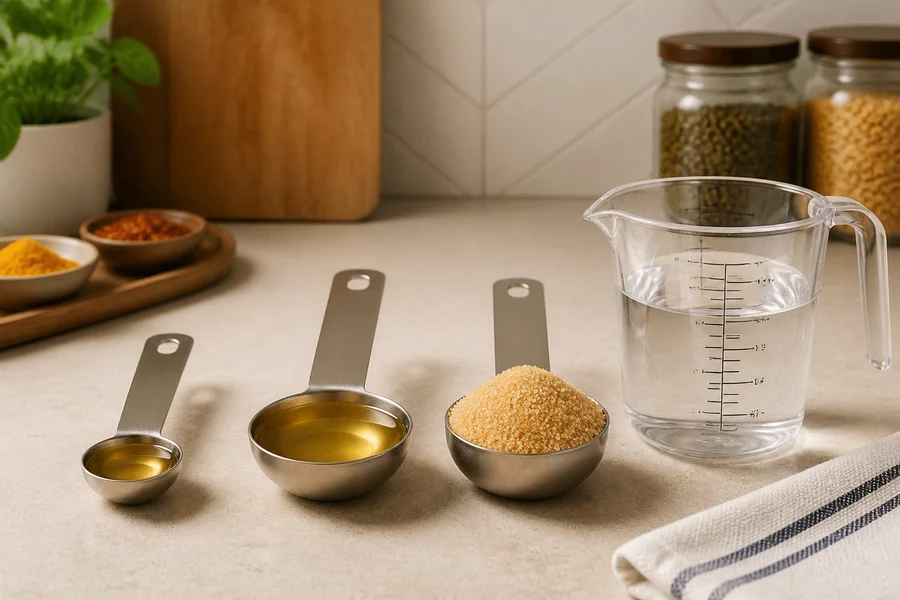
Quick Answer
For standard recipe measures, 1 teaspoon (tsp) = 5 ml and 1 tablespoon (tbsp) = 15 ml. One tablespoon equals 3 teaspoons. These are measuring standards, not the guaranteed capacity of an everyday household spoon.
Definitions
Standard teaspoon (tsp)
A recipe measuring unit equal to 5 millilitres in the metric kitchen-measurement system used for this article.
Standard tablespoon (tbsp)
A recipe measuring unit equal to 15 millilitres, or three standard teaspoons.
Level spoon
A spoonful filled to the rim and flattened so the ingredient is not piled above the spoon.
Heaped spoon
A spoonful with the ingredient mounded above the rim; its actual volume can vary depending on the ingredient and the size of the mound.
Household spoon
An everyday eating or serving spoon whose capacity is not standardised for recipe measurement.
One spoon in ml: the quick answer
In standard recipe measurement, 1 teaspoon is 5 ml and 1 tablespoon is 15 ml. Since 1 tablespoon equals 3 teaspoons, it also equals 15 ml.
Important: these are standard recipe measures. An ordinary spoon from your cutlery drawer may hold more or less than the stated amount.
- 1 tsp = 5 ml
- 2 tsp = 10 ml
- 1 tbsp = 15 ml
- 1 tbsp = 3 tsp = 15 ml
What tsp and tbsp mean in English recipes used in India
In English-language recipes, tsp means teaspoon and tbsp means tablespoon. These abbreviations indicate recipe measuring units, rather than a particular eating spoon.
If an instruction says only “one spoon”, it is incomplete or depends on the recipe’s context. Check the ingredient list, method, photos, video, or notes for tsp, tbsp, teaspoon, or tablespoon.
The Hindi search word “chammach” means spoon, but it still does not establish the intended size. You also need to know whether the recipe calls for a level or heaped spoonful.
- tsp means teaspoon: 5 ml
- tbsp means tablespoon: 15 ml
- A tablespoon is not automatically a soup spoon, serving spoon, or any specific piece of cutlery.
Why a household spoon may not equal a standard measuring spoon
Household spoons differ in bowl length, width, depth and overall shape, so their capacities are not standardised. A teaspoon-shaped eating spoon is not necessarily a 5 ml measuring spoon.
Likewise, a larger dining spoon or serving spoon should not automatically be used as a 15 ml tablespoon. The difference can matter in recipes where a little extra salt, spice, baking ingredient or liquid changes the result.
Use an everyday spoon only as a rough estimate when precision is not important and the recipe provides no clearer guidance.
- Household cutlery is useful for casual estimates, not repeatable measurement.
- Do not assume every small spoon holds 5 ml.
- Do not assume every large spoon holds 15 ml.
Level versus heaped: the same spoon can mean different amounts
A level spoon is filled to the rim, then flattened so that the ingredient does not rise above the edge. This is the usual approach for a standard spoon measure unless the recipe says otherwise.
A heaped spoon has a visible mound above the rim. It has no single ml value because the height and shape of the mound, as well as the texture of the ingredient, can vary.
Follow the recipe’s wording closely. For baking and other precision-sensitive cooking, use level standard measuring spoons unless the recipe specifically asks for a rounded or heaped measure.
- Level: filled to the rim and flattened.
- Heaped: visibly mounded above the rim.
- A heaped spoon cannot be converted into one exact ml figure.
How to interpret an ambiguous Indian recipe instruction
Start by checking whether the same recipe uses tsp, tbsp, teaspoon or tablespoon elsewhere. Consistent wording in the ingredient list often reveals what the author intended.
Next, look for a photo, video or author note that shows the spoon size and whether the ingredient is level or heaped. Consider the overall recipe scale too: an unusually large or small quantity may suggest informal wording, but it does not prove a fixed meaning.
If the source remains unclear, make a small test batch where practical and note the interpretation you used. Once you have decided that the intended unit is a teaspoon or tablespoon, use 5 ml or 15 ml for repeatable results.
- Check the full recipe before measuring.
- Look for visual cues and filling instructions.
- Test a smaller quantity when the result matters.
- Do not assume that “one spoon” always means tsp or always means tbsp.
When to use measuring spoons or a marked measuring cup
Use measuring spoons for small amounts such as 1 tsp, 1/2 tsp or 1 tbsp. They are especially helpful for baking, spice blends, sauces and recipes you want to repeat accurately.
Use a marked measuring cup for larger liquid quantities or whenever the recipe gives an amount in millilitres. A cup with clear ml markings can also make scaling a recipe easier.
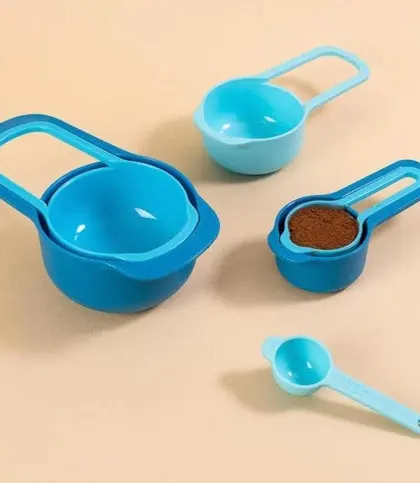
For a practical alternative to variable household cutlery, browse Measuring Cups Spoons for measuring cups and spoons suited to everyday recipe measuring.
- Choose measuring spoons for small measured additions.
- Choose a marked cup for larger liquid volumes.
- Prioritise standard tools when balance and consistency matter.
Measuring Cups & Spoons
₹295
Quick one-spoon-to-ml answers
These conversions apply to standard recipe measuring spoons. They describe volume, not weight.
Do not convert these ml amounts directly into grams without identifying the ingredient. Different ingredients have different densities, so the same volume can weigh differently.
- 1 standard teaspoon = 5 ml.
- 2 standard teaspoons = 10 ml.
- 1 standard tablespoon = 15 ml.
- 1 tablespoon = 3 teaspoons = 15 ml.
- A household spoon does not have a guaranteed ml capacity.
A simple rule for reliable recipe measuring
First name the unit: tsp or tbsp. Then use the standard metric conversion of 5 ml for a teaspoon or 15 ml for a tablespoon.
Keep level and heaped measures separate. Flatten a level measure, and do not treat a heaped spoonful as an exact ml amount.
When a recipe only says “one spoon” and the result matters, verify the source or switch to standard measuring tools rather than relying on ordinary cutlery.
- Identify tsp or tbsp before converting.
- Use 5 ml for tsp and 15 ml for tbsp.
- Use level measures unless another filling style is stated.
- Verify ambiguous instructions for baking and repeat recipes.
Final Verdict
- Use 5 ml when a recipe clearly specifies 1 standard teaspoon, and use 15 ml when it clearly specifies 1 standard tablespoon.
- An everyday household spoon is only an estimate because its capacity can vary.
- If the recipe says only “one spoon”, check its context and filling style. For accurate, repeatable cooking, use standard measuring spoons or a marked measuring cup.
FAQs
How many millilitres are in one standard teaspoon?
One standard teaspoon equals 5 ml in recipe measurement.
How many millilitres are in one standard tablespoon?
One standard tablespoon equals 15 ml. It is also equal to 3 standard teaspoons.
Does one household spoon always hold the same number of millilitres?
No. Everyday spoons vary in shape and depth, so their capacity is not guaranteed to match a standard measuring spoon.
What do tsp and tbsp mean in English recipes?
Tsp means teaspoon, which is 5 ml. Tbsp means tablespoon, which is 15 ml in the standard metric recipe system used here.
Does a level spoon differ from a heaped spoon?
Yes. A level spoon is filled to the rim and flattened. A heaped spoon has a mound above the rim, so its volume varies and has no one exact ml conversion.
How should an ambiguous spoon measurement in an Indian recipe be interpreted?
Look for tsp or tbsp elsewhere in the recipe, then check images, video or notes for the spoon size and filling style. If it is still unclear, use a small test batch where possible rather than assuming a fixed meaning.
When should a measuring spoon or marked cup be used instead?
Use measuring spoons for small amounts such as spices and baking ingredients, and a marked measuring cup for larger liquid quantities or stated ml amounts. They are most useful when accuracy and repeatability matter.
Keep exploring