


Mortar Pestle in Hindi: Names, Uses & How to Identify One
Quick Answer
In standard Hindi, the mortar is called ओखली (okhalī, roughly “oh-khuh-lee”) and the pestle is called मूसल (mūsal, roughly “moo-suhl”). The ओखली is the bowl; the मूसल is the handheld tool used inside it. Together, they are called an ओखली-मूसल set.
Definitions
Mortar
The stationary bowl or cup-shaped vessel in which ingredients are placed and crushed. In Hindi, the standard term is ओखली (okhalī).
Pestle
The handheld club- or baton-shaped tool used to pound, crush, or grind ingredients inside the mortar. In Hindi, the standard term is मूसल (mūsal).
ओखली-मूसल
The Hindi pairing for a mortar-and-pestle set: ओखली is the bowl and मूसल is the pounding tool.
सिल-बट्टा
A traditional flat grinding set made from a stone slab and a separate hand stone. It is useful for comparison but is not the same form as a bowl-shaped mortar and pestle.
Mortar and Pestle in Hindi: The Short Answer
The standard Hindi word for a mortar is ओखली (okhalī), while a pestle is मूसल (mūsal). The distinction is simple: the ओखली is the stationary hollow bowl, and the मूसल is the handheld tool used to crush ingredients inside it.
When referring to both pieces together, use ओखली-मूसल. A practical kitchen example is: “ओखली में मसाले डालें और मूसल से कूटें” — put spices in the mortar and pound them with the pestle.
- Mortar: ओखली
- Pestle: मूसल
- Mortar-and-pestle set: ओखली-मूसल
Hindi Names, Transliteration and Pronunciation
Roman spellings are useful search aids, but they are approximate: English letters cannot capture every Hindi sound exactly. You may also see slightly different spellings in informal Roman Hindi.
For clear communication while shopping, cooking, or describing the tool, use the Hindi name alongside the English component name.
- ओखली — okhalī — mortar — roughly “oh-khuh-lee”
- मूसल — mūsal — pestle — roughly “moo-suhl”
- ओखली-मूसल — okhalī-mūsal — mortar-and-pestle set
Common Regional and Colloquial Variants
Kitchen vocabulary varies by household, region, and language. ओखल (okhal) may appear as a related or shortened form in some speech, but it should not be treated as a universally interchangeable name everywhere.
If the exact noun is unclear, a descriptive phrase such as कूटने वाला मूसल, meaning a pestle for pounding, can help make the purpose clear. When terms vary, use the physical shape to identify the tool rather than relying only on a name.
A common point of confusion is सिल-बट्टा (sil-baṭṭā). It is a flat stone grinding setup with a slab and hand stone, not a hollow bowl with a pestle. Both are traditional kitchen tools, but their forms and motions differ.
- ओखल may occur as a related or shortened regional form.
- Descriptive phrases can be helpful in everyday conversation.
- सिल-बट्टा is a flat grinding tool, not another name for every ओखली-मूसल.
Everyday Kitchen Uses of an ओखली-मूसल
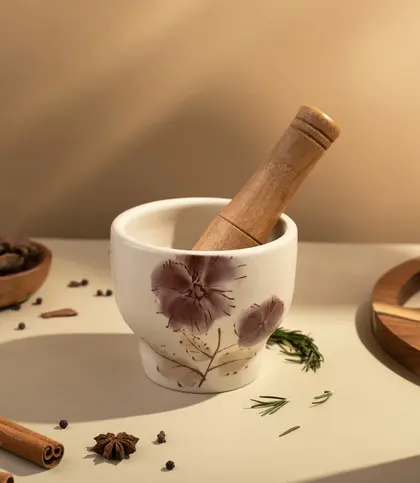
An ओखली-मूसल is useful for small kitchen tasks where a freshly crushed or deliberately coarse texture is wanted. It can crush whole spices, pound garlic and ginger, bruise herbs, or break chillies into a paste or rough mixture.
Choose a bowl with enough room to keep ingredients contained while pounding, and a pestle that feels secure in the hand. Porcelain and wood are two materials used for this familiar bowl-and-pestle format.
- Crushing small quantities of whole spices for cooking
- Pounding garlic, ginger, chillies, and herbs
- Making a coarse spice blend or textured paste
- Preparing small batches by hand
₹475
₹725
34%OFF

₹699
₹1,378
49%OFF
How to Identify a Genuine Mortar-and-Pestle Set
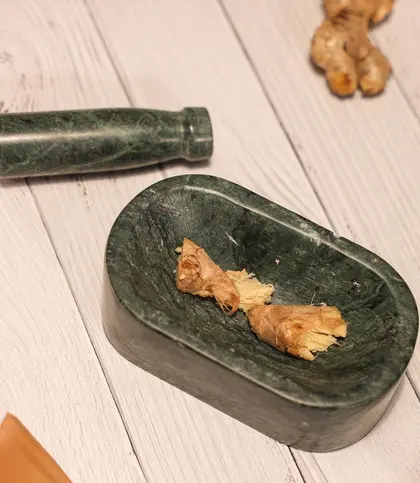
Identify a mortar-and-pestle set by its two matching parts. The mortar, or ओखली, is a hollow bowl or cup with a stable base. The pestle, or मूसल, is a separate rounded, club-shaped, or baton-like implement that fits comfortably into the bowl.
The bowl should sit without wobbling and be deep enough to help contain ingredients during use. Stone, marble, wood, ceramic, porcelain, and metal can all be used for these tools; the defining feature is the bowl-and-pestle design, not the material alone.
Marble examples make the two-piece structure especially easy to recognise, but the same identification principles apply across materials.
- Look for one hollow, stable bowl.
- Look for one separate handheld pounding tool.
- Check that the pestle is intended to be used inside the bowl.
- Do not confuse it with a flat सिल-बट्टा, a rolling pin, or an ordinary mixing bowl.

₹2,266
₹2,450
8%OFF
₹1,000
₹1,250
20%OFF
Quick Identification Checklist
Use this quick check when sorting kitchen tools or reading a product description. If the answers are mostly yes, you are looking at a true mortar-and-pestle set, or ओखली-मूसल.
- One hollow bowl or cup-shaped vessel is present.
- One separate handheld pounding tool is included.
- The handheld tool works inside the bowl, rather than across a flat slab.
- The bowl has a stable base and the pestle is comfortable to hold.
- The item is described as a two-piece mortar-and-pestle or ओखली-मूसल set.
- It is intended for small-batch crushing, pounding, or grinding in the kitchen.
Bilingual Glossary and Final Takeaway
Remember the component difference: ओखली holds, and मूसल pounds. This is the easiest way to use the Hindi names correctly in a kitchen conversation or search.
If you want a true mortar-and-pestle set, choose the item with one hollow bowl and one matching handheld pestle. A flat slab and hand stone is a सिल-बट्टा, which is a different kind of grinding tool.
- Mortar: ओखली (okhalī)
- Pestle: मूसल (mūsal)
- Mortar and pestle: ओखली-मूसल (okhalī-mūsal)
- Flat grinding stone set: सिल-बट्टा (sil-baṭṭā)
Final Verdict
- The bowl-shaped component is the ओखली, or mortar; the handheld pounding tool is the मूसल, or pestle.
- Together, they form an ओखली-मूसल set.
- To identify the correct kitchen implement, look for a stable hollow bowl and a matching pestle, not a flat सिल-बट्टा, rolling pin, mixing bowl, or powered appliance.
FAQs
What are mortar and pestle called in Hindi?
A mortar is called ओखली (okhalī) and a pestle is called मूसल (mūsal) in standard Hindi. Together, the set is called ओखली-मूसल.
Which Hindi word refers to the mortar and which to the pestle?
ओखली refers to the hollow bowl that holds the ingredients. मूसल refers to the handheld tool used to pound or crush them inside the bowl.
What regional or colloquial Hindi names are commonly used?
Usage can vary by region and household. ओखल may occur as a related or shortened form in some contexts, while descriptive phrases such as कूटने वाला मूसल may be used for a pounding tool. These forms are not necessarily interchangeable everywhere.
How are ओखली and मूसल pronounced?
ओखली is approximately pronounced “oh-khuh-lee,” and मूसल is approximately “moo-suhl.” Roman spellings are approximate, so pronunciation and spelling can vary slightly in informal use.
Is सिल-बट्टा the same as a mortar and pestle?
No. A सिल-बट्टा is a flat grinding set with a slab and a hand stone. An ओखली-मूसल has a hollow bowl and a pestle used inside that bowl.
What are mortar and pestle used for in the kitchen?
They are commonly used to crush whole spices, pound garlic and ginger, bruise herbs, break chillies, and prepare small quantities of coarse mixtures or pastes.
How can I identify a mortar-and-pestle set?
Look for two pieces: a stable, hollow bowl and a separate handheld pestle that fits inside it. The tool should be designed for pounding or crushing ingredients within the bowl.