


Mortar and Pestle en Español: Names and Pronunciation
Quick Answer
In Spanish, a mortar and pestle is usually called un mortero y una mano de mortero. El mortero is the bowl, while la mano de mortero is the handheld grinding tool. Regional alternatives exist, but this standard pair is the clearest choice for general communication and shopping.
Definitions
Mortero
The Spanish term most commonly used for the bowl or vessel in which ingredients are crushed or ground; usually masculine: el mortero.
Mano de mortero
The Spanish term for the handheld grinding tool used with the bowl; literally, “hand of the mortar.”
Pilón
A regional or context-dependent term that can refer to a mortar, often a larger or traditional one; its exact use varies by country.
Majadero
A regional or less universal term that may refer to the pestle or a pounding tool; confirm the intended component from context.
Set de mortero y mano
A shopping phrase for the complete two-piece set, consisting of the bowl and the handheld grinding tool.
Mortar and Pestle en Español: The Quick Answer
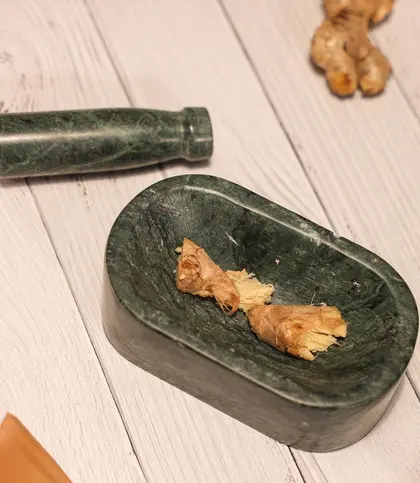
The most useful general translation is mortero y mano de mortero. This distinction matters: el mortero is the bowl-shaped vessel, and la mano de mortero is the piece held in the hand to crush or grind.
You may hear other names in different Spanish-speaking regions, but mortero and mano de mortero are the safest terms to begin with when speaking to a seller, reading a listing, or labeling the two parts.
Which Spanish Name Refers to Each Part?
Use the component names separately when you need to be precise. The phrase mano de mortero literally suggests the “hand of the mortar,” which can make it easier to remember that it is the handheld tool rather than the bowl.
Useful shopping phrases include un mortero con su mano and un set de mortero y mano. They signal that you are looking for the complete paired tool, not a bowl alone.
- El mortero: the bowl or vessel.
- La mano de mortero: the handheld pestle used with the bowl.

₹699
₹1,378
49%OFF
Regional Variants and Literal Meanings
Spanish vocabulary varies by country and sometimes by household or product category. Pilón can describe a mortar in some Latin American contexts, especially a larger or more traditional vessel. Its exact meaning is not identical everywhere.
You may also encounter majadero or machacador for a pounding or crushing tool. These words are context-dependent and do not reliably identify the same component in every region. When a regional term appears, check the image, description, or whether both pieces are mentioned.
For clear general communication, use mortero for the bowl and mano de mortero for the pestle. Treat other terms as useful local clues rather than universal replacements.
How to Pronounce Mortero and Mano de Mortero
For an English-speaking reader, mortero is approximately mor-TEH-roh. Mano is approximately MAH-noh, and de sounds like deh. Put together, mano de mortero is approximately MAH-noh deh mor-TEH-roh.
The stress in mortero falls on TEH, while mano is stressed on MAH. Keep the vowels clear rather than reducing them in an English-style way. The Spanish r and the sound of de can vary by region, so these cues are practical approximations rather than a substitute for listening practice.
In IPA, mortero may be written /moɾˈteɾo/, and mano de mortero as /ˈmano ðe moɾˈteɾo/.
How to Identify the Right Tool When Shopping
Search using mortero, mano de mortero, mortero y mano, or set de mortero y mano. Then look beyond the name: a complete set should show a bowl-shaped vessel and a matching handheld pestle.
A listing that says only mortero may refer to the bowl alone. To avoid an incomplete purchase, ask: “¿Incluye la mano de mortero?” This means, “Does it include the pestle?”
Product names can reinforce the vocabulary without replacing a close look at the listing. A clearly described two-piece set, such as Zelvora Mortar and Pestle Set - Two Piece Set, illustrates the type of wording that signals both components are included.
- Search for both component names, not only mortero.
- Confirm that the image shows a bowl and handheld pestle together.
- Ask whether the mano de mortero is included when the description is unclear.
₹1,000
₹1,250
20%OFF
Mortar and Pestle vs Similar Kitchen Tools
A mortar-and-pestle set is defined by its paired design: a bowl that holds the ingredients and a handheld tool that works inside it. Not every kitchen item described as a grinder, crusher, or bowl has this form.
A molinillo or molino generally refers to a mill or grinding device, which may work differently and may not include a matching bowl. A machacador can mean a masher or crushing tool and may be handheld without a mortar.
Terms such as triturador eléctrico, procesador de alimentos, and licuadora refer to powered equipment. A decorative bowl can also resemble a mortero, but it is not necessarily intended for kitchen use or sold with a mano de mortero.
A Simple Spanish Shopping Checklist
Before buying or asking a seller, use this short checklist to make sure the name and the product match.
- Call the bowl el mortero.
- Call the handheld tool la mano de mortero.
- Ask: “¿Es un set de mortero y mano?”
- Check for a bowl-and-pestle pair in the image and description.
- If you see a regional term, ask which component it describes.
- Confirm that it is a manual kitchen set, not a mill, electric appliance, masher, or decorative bowl.
Final Verdict
- For general use, say mortero y mano de mortero.
- Remember that el mortero is the bowl and la mano de mortero is the handheld grinding tool.
- When shopping, confirm that both pieces are included rather than assuming mortero refers to a full set.
- Treat terms such as pilón, majadero, and machacador as context-dependent regional vocabulary.
FAQs
What is mortar and pestle called in Spanish?
The clearest general term is mortero y mano de mortero. Mortero names the bowl, and mano de mortero names the handheld pestle.
Which Spanish term refers to the bowl and which to the grinding tool?
El mortero is the bowl or vessel. La mano de mortero is the tool held in the hand for crushing and grinding.
Do the names vary by country or region?
Yes. You may encounter terms such as pilón, majadero, or machacador, but their meaning and frequency vary by place and context. Mortero and mano de mortero are dependable general terms.
How do you pronounce mortero and mano de mortero?
Say mortero approximately as mor-TEH-roh, and mano de mortero as MAH-noh deh mor-TEH-roh. These are approximate English-reader cues; regional Spanish pronunciation differs.
How can I identify a mortar and pestle in a Spanish listing?
Look for mortero y mano, mano de mortero, or set de mortero y mano. Check that the listing shows and describes both a bowl-shaped vessel and a matching handheld tool.
Does mortero always mean that the pestle is included?
No. Mortero can refer specifically to the bowl. If the listing is unclear, ask “¿Incluye la mano de mortero?” to confirm that the pestle is included.
What is the difference between a mortar and pestle and a molinillo?
A mortar and pestle is a manual bowl-and-hand-tool pair. A molinillo is generally a mill or grinding device and may have a different design without a matching bowl.