

Quick Answer
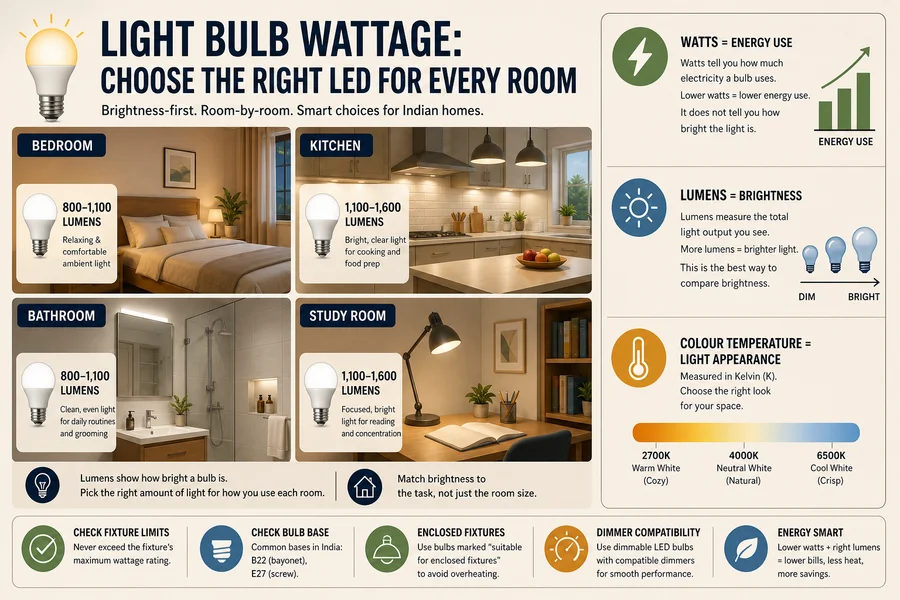
For most Indian homes, choose an LED bulb by lumens rather than watts. As a starting point, use about 800–1,100 lumens for a typical bedroom or bathroom and about 1,100–1,600 lumens for a kitchen or study task area. Then check the bulb’s actual wattage against the fixture limit, and confirm its base, size, enclosed-fixture rating and dimmer compatibility. These ranges are starting points: room size, daylight, wall colours, shades and the number of bulbs all affect the result.
Definitions
Wattage
The amount of electrical power a bulb uses, measured in watts (W). It helps estimate energy consumption and check fixture limits, but it does not by itself tell you how bright a bulb will look.
Lumens
The amount of visible light a bulb produces. Lumens are the more useful specification when comparing the brightness of LED bulbs.
Colour temperature
The appearance of the light, measured in kelvins (K). Lower values generally look warmer or more yellow; higher values generally look cooler or more bluish.
LED bulb
A light-emitting diode bulb that typically produces comparable light to older bulb technologies while using less electrical power, depending on the specific products being compared.
Fixture maximum wattage
The highest bulb wattage the light fitting is designed to support. The bulb selected should not exceed this rating.
Bulb base
The socket-fitting part of the bulb, such as a common screw or pin base. It must match the fixture’s socket.
Light bulb wattage: the quick answer
Watts tell you how much electricity a bulb uses; lumens tell you how much light it produces. When replacing an older bulb with an LED, start with the lumen figure on the pack rather than trying to match wattage exactly.
For a typical general-lighting point, around 800–1,100 lumens is often a comfortable starting range for a bedroom or bathroom. A kitchen or study task area often benefits from roughly 1,100–1,600 lumens. The right choice changes with room size, daylight, ceiling height, dark or light finishes, shades and the total number of bulbs in use.
- Choose brightness in lumens first.
- Use watts to compare power consumption and stay within the fixture’s stated limit.
- Choose colour temperature for the look of the light, not as a measure of brightness.
- Check base, size, enclosed-fixture suitability and dimmer compatibility before buying.
Watts, lumens and colour temperature: what each label means
Wattage is electrical power consumption. With LED bulbs, a low wattage can still provide substantial light output, so watts alone are no longer a reliable shortcut for brightness. Two bulbs using different wattages may produce similar lumens, while two bulbs with the same wattage may not look equally bright.
Lumens measure the visible light output. If you want more light in a room, compare lumens first. Colour temperature, shown in kelvins (K), describes whether light appears warm and yellowish or cooler and whiter. It changes the character of a room, but it does not replace the need for enough lumens.
Perceived brightness also depends on where the light goes. A directional bulb, opaque shade, diffuser, high ceiling, dark wall colour or deep fitting can make a room feel less bright even when the bulb has a high lumen rating.
- Watts: power used by the bulb.
- Lumens: light output from the bulb.
- Kelvins: warm-to-cool appearance of the light.
- Fixture design and room surfaces affect how bright the light feels.
Choose LED brightness room by room
Use these ranges as practical starting points for a single general bulb or a focused task area, not as fixed rules. A larger room, dark surfaces or a high ceiling may need more total lumens. In many homes, several lower-output bulbs placed well can give more even illumination than one very bright bulb.
For a bedroom, about 800–1,100 lumens from a general bulb is often a comfortable starting point. Warm light is commonly chosen for a relaxed ambient look. If you read in bed, consider the reading area separately: its light should be directed where you need it rather than relying only on the room’s main bulb.
For a kitchen, aim for bright, even coverage. Around 1,100–1,600 lumens can be a useful starting range for a main bulb or task-focused area. One bulb may not sufficiently light worktops, corners or cabinet fronts, so consider the total light across the space rather than only the output of one bulb.
For a bathroom, around 800–1,100 lumens is often a useful starting point for a typical general-lighting point. Neutral-looking light can be practical around a grooming area. Follow the fitting’s requirements for use in moisture-prone locations.
For a study room, around 1,100–1,600 lumens can suit a main light or task-focused area. Neutral to cooler-looking light is often preferred for its clear visual appearance during reading, writing or screen-free desk work. Position and glare control matter as much as output, especially around a desk.
- Bedroom: 800–1,100 lumens for typical general lighting; add separate light where focused reading is needed.
- Kitchen: 1,100–1,600 lumens for a main bulb or task area; assess worktops and corners separately.
- Bathroom: 800–1,100 lumens for typical general lighting; follow moisture-related fixture guidance.
- Study room: 1,100–1,600 lumens for main or task-focused lighting; avoid glare on the work surface.
- For larger or darker rooms, increase total lumens or use more than one bulb for better distribution.
How to match an LED to an older incandescent bulb
If you are replacing an incandescent bulb, compare its labelled light output where possible. If the old packaging is unavailable, the LED pack may show an incandescent-equivalent statement, but the lumen figure remains the more direct comparison.
These common shorthand comparisons are approximate. Beam shape, cover design and the fitting itself can alter how the resulting light looks in a room. An LED labelled 9W may give light similar to a 60W incandescent, but 9W and 60W describe power use, not equal wattage performance.
- 40W incandescent: often replaced by an LED of about 450 lumens.
- 60W incandescent: often replaced by an LED of about 800 lumens.
- 75W incandescent: often replaced by an LED of about 1,100 lumens.
- 100W incandescent: often replaced by an LED of about 1,600 lumens.
- Treat these as approximate comparisons and prioritise the LED’s labelled lumens.
Check the fixture before buying
After choosing the brightness, make sure the bulb is suitable for the existing fitting. First, find the fixture’s maximum wattage label or manufacturer instructions. Do not exceed that limit, and use the LED bulb’s actual wattage for this check, not an incandescent-equivalent claim on the packaging.
Match the bulb base to the socket, then check the bulb shape and dimensions. A bulb should seat correctly and have enough clearance from the shade or fitting. If the bulb will be fully surrounded by a cover, choose one explicitly labelled as suitable for enclosed fixtures; trapped heat can affect suitability and service life.
If the circuit uses a dimmer, choose a bulb labelled dimmable and check its stated compatibility guidance. Not every dimmable LED performs smoothly with every dimmer. Also confirm the product’s electrical specifications are appropriate for your household supply and follow the fixture and bulb manufacturer guidance.
- Stay at or below the fixture’s maximum wattage using the LED’s actual wattage.
- Match the socket base, bulb shape and physical dimensions.
- Use an enclosed-fixture-rated LED when the bulb is fully enclosed.
- Use dimmable bulbs only with a dimmer and check compatibility guidance.
- Do not alter wiring, repair switches or install fixtures as part of choosing a bulb.
Compare energy use and colour before purchase
To estimate electricity use, multiply the bulb’s wattage by the hours it will run, then divide by 1,000 to get kilowatt-hours. For example, a 9W LED used for 100 hours consumes about 0.9 kilowatt-hours. This lets you compare bulbs with different actual wattages on the same basis.
A lower-wattage LED can use less energy while delivering comparable lumens to an older incandescent bulb, although efficiency differs between products. Do not assume that the lowest-watt bulb is automatically bright enough; compare lumens alongside watts.
For light appearance, warmer colour temperatures usually suit a relaxed bedroom ambience. Neutral or cooler-looking options can suit kitchen work, bathroom grooming and study tasks when you prefer a clearer white appearance. Select the appearance you like after confirming the bulb provides enough light.
- Identify the room use: relaxing, cooking, grooming, reading or study.
- Set a target lumen range for the space and task.
- Choose a colour temperature that gives the appearance you prefer.
- Check actual wattage against the fixture limit.
- Confirm base, bulb dimensions, enclosed-fixture suitability and dimmer compatibility.
- Decide how many bulbs are needed for even coverage rather than judging one bulb in isolation.
Frequently asked questions about light bulb wattage
The most useful bulb choice combines enough lumens for the room, a colour temperature you like, safe compatibility with the fitting and an acceptable level of energy use. Check the label for all of these details before purchase.
Final Verdict
- Select LED bulbs by target lumens first: approximately 800–1,100 lumens is a practical starting range for a typical bedroom or bathroom, while 1,100–1,600 lumens can suit a kitchen or study task area.
- Then choose the light appearance you prefer, often warmer for relaxed bedroom ambience and neutral or cooler-looking light for task-oriented rooms.
- Before buying, verify the actual LED wattage is within the fixture limit, and confirm the base, dimensions, enclosed-fixture rating and dimmer compatibility.
- A bulb is a suitable choice only when it provides enough light, works safely with the fitting and uses an acceptable amount of power for how long you expect to use it.
FAQs
What does bulb wattage measure?
Bulb wattage measures electrical power use in watts. It helps estimate energy consumption and check the fixture’s maximum permitted wattage, but it does not by itself tell you how bright an LED bulb will be.
Why are lumens more useful than watts for brightness?
Lumens measure light output, so they are the better figure for comparing LED brightness. LEDs can use different wattages while producing similar lumens, and bulbs with the same wattage can have different light output.
What LED brightness is best for a bedroom?
For a typical bedroom general-lighting point, around 800–1,100 lumens is a useful starting range. Consider a warmer light appearance for ambient use, and assess reading areas separately if you need focused light there.
How do I choose an LED bulb for a kitchen?
For a kitchen main bulb or task-focused area, roughly 1,100–1,600 lumens is often a practical starting range. Check whether the worktops, corners and cabinet areas receive enough light, as one bulb may not cover the entire room evenly.
Can I use a higher wattage bulb in a fixture?
No. Do not exceed the fixture’s stated maximum wattage. Check the LED bulb’s actual wattage, rather than its incandescent-equivalent wording, and follow the fixture manufacturer’s instructions.
How do I match an LED bulb to an old incandescent bulb?
Compare lumens where possible. Approximate replacements are 450 lumens for a 40W incandescent, 800 lumens for 60W, 1,100 lumens for 75W and 1,600 lumens for 100W. Actual results can vary with bulb design and the fitting.
What should I check for dimmers and enclosed fixtures?
For a dimmer, choose a bulb labelled dimmable and review its compatibility guidance, since some dimmer-and-bulb combinations may not operate smoothly. For a fully enclosed fitting, use an LED explicitly rated for enclosed fixtures.
How can I compare bulb energy use?
Multiply actual wattage by expected hours of use and divide by 1,000 to estimate kilowatt-hours. Compare that result alongside lumens, because a lower-watt bulb is useful only if it still provides enough light for the room.
Keep exploring