

Quick Answer
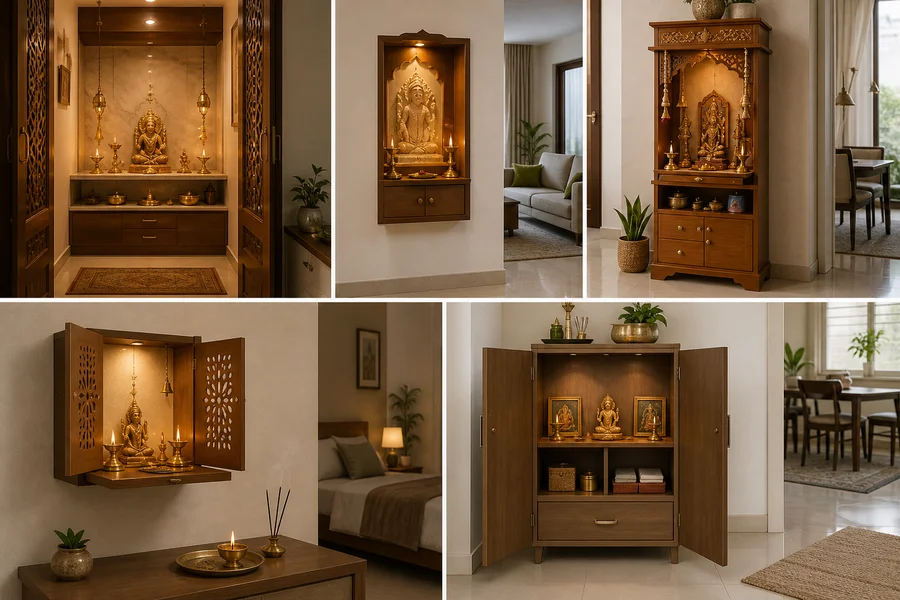
Choose a house mandir design by assessing four practical constraints first: available floor or wall area, ownership and permission limits, prayer frequency, and storage needs. A dedicated pooja room can suit larger homes with regular, storage-heavy worship; a recessed niche works in planned interiors; a freestanding unit offers flexibility; a wall-mounted unit preserves floor space; and a converted cabinet can be a reversible option for renters. Whichever format you choose, preserve circulation, allow cleaning and ventilation, and use diyas and incense only with stable, supervised arrangements away from children, pets and combustible materials.
Definitions
Mandir
A Hindu prayer space or shrine in a home. In this article, it may refer to a room, niche, furniture unit or adapted cabinet.
Pooja
Worship or devotional practice. The article uses the English term to describe household prayer routines and related items.
Recessed niche
A prayer space built into or set within a wall or planned joinery, rather than standing as a separate piece of furniture.
Converted cabinet
An existing cabinet adapted for prayer use, subject to suitable dimensions, ventilation, cleanability and safe placement.
House Mandir Design: Start With the Format, Not the Finish
A house mandir design works best when it begins with the household rather than a finish, carving or decorative detail. A mandir is a Hindu prayer space, while pooja refers to worship or devotional practice. The right arrangement can therefore look very different in a compact flat, a rented home and a larger family house.
Start with four questions: How much space is genuinely available? Do you own or rent? How often will the space be used? And what must it store? Your answers will help you compare five practical formats: a dedicated pooja room, a recessed niche, a freestanding unit, a wall-mounted unit and a converted cabinet.
- Choose a format before choosing a material or style.
- Match the footprint to the room’s movement routes, not just to an empty-looking wall.
- Treat household traditions and preferences as personal considerations rather than universal placement rules.
Mandir for home
₹1,496
₹2,199
32%OFF
₹3,182
₹5,999
47%OFF
₹1,139
₹2,499
54%OFF

₹2,845
₹4,200
32%OFF
₹1,499
₹1,899
21%OFF
₹899
₹1,699
47%OFF
₹1,529
₹1,899
19%OFF

₹2,845
₹4,200
32%OFF
The Five-Minute House Mandir Design Checklist
Use this quick screen to narrow the choice before measuring products. It is often more useful to identify the least complicated format that supports your routine than to create a larger setup than the room can comfortably hold.
- Small flat with limited floor area: investigate a wall-mounted unit, a compact converted cabinet or a small freestanding mandir.
- Rented home: favour movable formats, and do not assume permission for drilling, joinery or electrical changes.
- Larger owned home with frequent prayer and substantial supplies: assess whether a dedicated room or planned niche is practical.
- Daily prayer: prioritise easy reach, a stable surface, wipeable finishes and storage for regularly used items.
- Festive prayer: allow for temporary trays, extra vessels, flowers, cloths and waste handling without permanently blocking circulation.
- Children or pets in the home: favour stable, supervised arrangements and keep flames, incense and fragile objects out of reach.
₹899
₹1,699
47%OFF
Compare the Five Mandir Formats
A dedicated pooja room provides the greatest separation, privacy and potential storage. It can make sense when the home has sufficient area and the routine justifies giving a room or enclosed zone to prayer. In a home where pooja is occasional, however, that footprint may be more than the household needs.
A recessed niche integrates neatly into a planned wall or cabinet run, preserving visual and floor space. It is less easy to alter later, so it is best considered during renovation or joinery planning, with owner approval and professional input where needed.
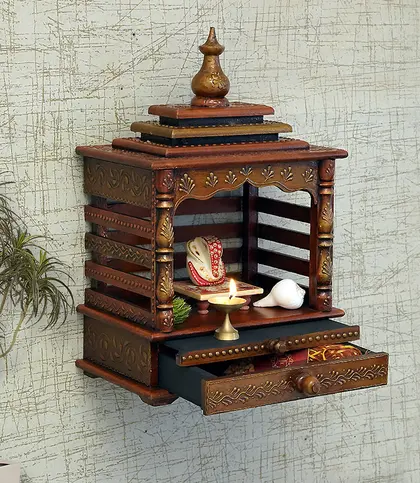
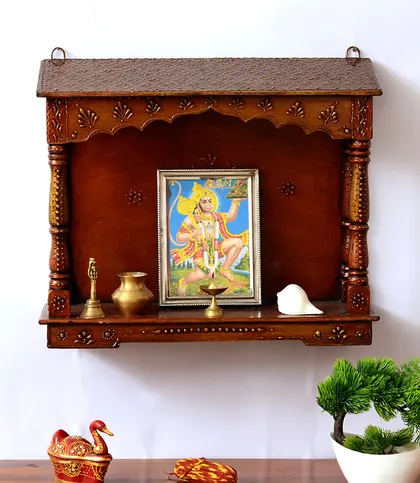
A freestanding unit is straightforward to move, replace or reposition as a layout changes. It can be useful in rented homes and flexible interiors, but it needs adequate floor area and clearance around walkways, doors and drawers. A traditional wood-and-MDF option such as Heritage Pavilion Mango Wood & MDF Mandir - Brown can help when comparing freestanding proportions and finishes.
A wall-mounted unit can preserve valuable floor space in a compact flat. Its practicality depends on the wall condition, fixing method, load and a comfortable reach height. Product dimensions alone do not confirm that mounting is suitable; uncertain installation should be assessed by a qualified professional.
A converted cabinet can reuse existing furniture while concealing supplies behind doors. It may be especially useful in a rental, provided its internal dimensions allow a comfortable setup, surfaces can be cleaned, airflow is considered and unsuitable contents are stored separately.
- Dedicated pooja room: highest space and storage potential; least portable; best assessed for frequent use.
- Recessed niche: low visual impact and no extra floor area; difficult to change; suited to planned interiors.
- Freestanding unit: portable and replaceable; needs floor clearance; suited to flexible layouts.
- Wall-mounted unit: saves floor space; installation-dependent; suited to a suitable, professionally assessed wall.
- Converted cabinet: reversible and storage-friendly; requires careful internal planning; suited to homes with appropriate existing furniture.
₹1,496
₹2,199
32%OFF
Place the Mandir Without Blocking the Home
Before choosing a wall or floor position, map the main walking route through the room. Include door swings, drawers, windows, seating, cleaning access and the space needed to stand or sit in front of the mandir. A position that appears open on a plan may become congested once furniture is used every day.
In a living room, a freestanding, niche or wall-mounted design should not compete with primary seating or the route between the entrance and seating. In an entryway, make sure the unit does not narrow the approach or sit where bags, footwear, dust and accidental knocks are common. In a bedroom, choose a position that works with the household’s routine without obstructing wardrobes, windows or circulation.
There is no universal direction or room placement that guarantees a religious or Vastu outcome. Household practice, cultural preference and professional advice may differ. For drilling, joinery, load-bearing questions or electrical changes, speak with the owner, building authority or a qualified professional as appropriate.
- Keep enough clear floor space in front for use and cleaning.
- Avoid locations where a door can strike the unit or where cabinet doors cannot open fully.
- Check ventilation without placing a flame or smoke source in a draught or near curtains, paper or other combustible materials.
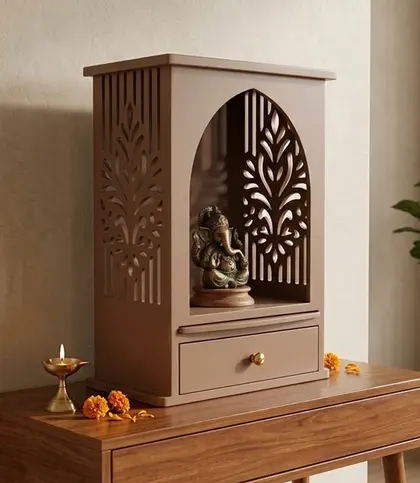
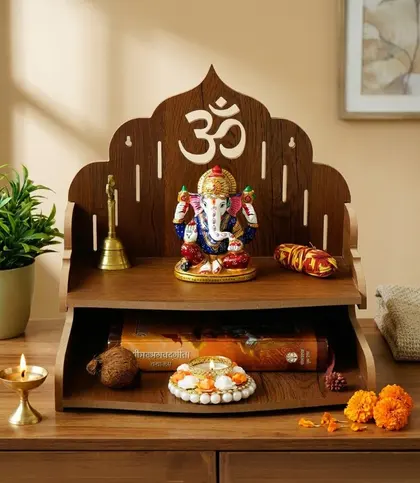
- Use a decorative MDF format such as Serenity Arch MDF Mandir - Brown only after confirming that its planned location works with the room’s circulation.
₹3,182
₹5,999
47%OFF
What to Measure Before Buying a Mandir Unit
Measure the complete setup, not only the available gap or the listed size of a mandir. Record the width, height and depth at the intended location, then note skirting, ledges, switches, windows, uneven walls and handle projection. Take photographs and make a simple scaled sketch before shopping.
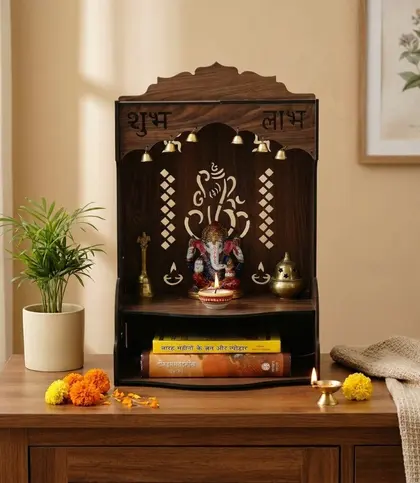
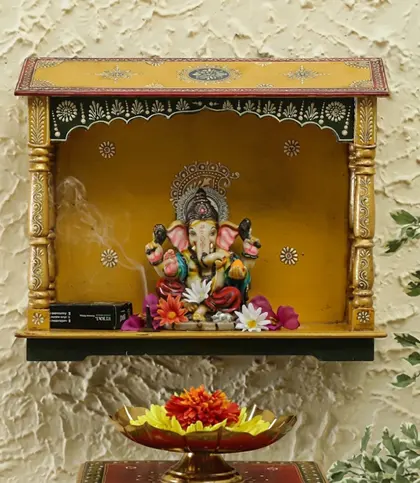
Also measure the clear area in front of the unit for standing, seating, cleaning and opening any doors or drawers. Consider the reach needs of the people who will use the space, as well as the height of nearby furniture. A compact wooden format such as Heritage Wooden Mandir may suit everyday use only if its full footprint and access area fit comfortably.
- Measure the largest idol or devotional object, along with trays, lamps, vessels and framed items.
- Allow for cabinet-door swing, cables where relevant and the reach needed to wipe all surfaces.
- For wall-mounted designs, check the wall and proposed fixing location; listed product size is not evidence of installation suitability.
- Verify the seller’s dimensions, assembly method and care instructions before purchase.
₹1,139
₹2,499
54%OFF
Plan Storage for Daily and Festive Pooja Items
Separate daily-use items from festive and seasonal supplies before deciding how much storage is needed. Lamps, incense, matches or lighters, cloths and small vessels may need quick access, while extra containers, seasonal decor and backup supplies can often live in closed storage nearby.
Open shelves can make daily items easy to reach, but enclosed drawers or cabinets can reduce visual clutter and protect dust-sensitive supplies. A removable tray is useful for grouping regular items and clearing the prayer surface for cleaning. Avoid filling the main surface so fully that wiping or arranging it becomes difficult.
- Use accessible shelves or drawers for items used often.
- Choose closed, labelled storage for seasonal or infrequently used supplies.
- Check that storage doors open without narrowing a walkway.
- Keep combustible materials away from any active flame and follow product guidance with supervision.
Materials, Cleanability, Diyas, Incense, Children and Pets
Material choice is also a maintenance decision. Wood and engineered wood can work in traditional or contemporary interiors, but finishes vary, so confirm care guidance and protect surfaces from standing oil or water. Stone may feel durable but can add significant weight, while metal accessories may be easy to wipe yet become hot near a flame.
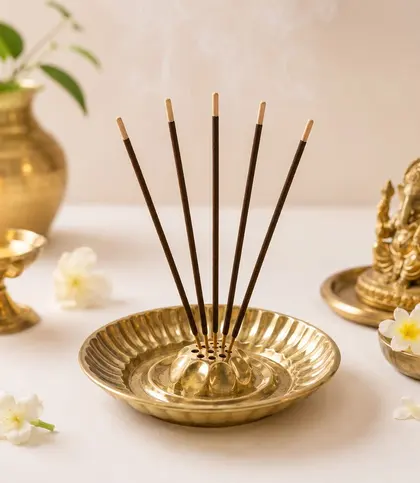
If dust and ash are regular concerns, accessible smooth surfaces are generally easier to maintain than deep grooves or delicate detailing. Keep diyas and incense on stable, heat-appropriate accessories with clear surrounding space. Never leave a flame or burning incense unattended, and provide ventilation while avoiding drafts or proximity to curtains, paper, wood and other combustible materials.
With children and pets, consider height, unit stability, sharp edges, trailing cords and access to hot or breakable items. For any uncertain fire, electrical, structural or mounting question, consult a qualified professional rather than relying on a general design recommendation.
- Confirm manufacturer cleaning instructions for the exact finish.
- Wipe spills promptly according to care guidance rather than assuming all wood, MDF, metal or stone tolerates the same treatment.
- Use a dedicated incense accessory, such as Dhyan Deep Incense Holder - Gold, according to its use guidance.
- Keep flames, hot accessories and fragile objects inaccessible to children and pets.

₹399
₹999
60%OFF
Incense Holders
₹399
₹999
60%OFF

₹999
₹1,299
23%OFF
₹349
₹509
31%OFF
₹449
₹699
36%OFF

₹249
₹1,499
83%OFF

₹199
₹799
75%OFF

₹2,061
₹3,675
44%OFF
₹149
₹233
36%OFF
Choose by Household: A Practical Format-and-Placement Decision Path
For a compact flat, begin with a wall-mounted, compact freestanding or converted-cabinet option. Choose a low-traffic position, keep a clear front area and use nearby storage rather than oversizing the unit. A small freestanding option such as Bhakti Bhavan Wooden Mandir Mandir can be worth investigating where a movable setup is more practical than wall alterations.
For a rented home, start with a movable freestanding mandir or a suitable converted cabinet. Confirm landlord and building permissions before drilling or changing joinery. For a larger family home, a dedicated pooja room or freestanding unit may be reasonable when regular use and storage needs justify the footprint.
For frequent daily prayer, prioritise an accessible surface, nearby daily storage, ventilation and an easy route to the space. For occasional or festive pooja, a compact unit plus a separate temporary tray or storage solution is often more practical than permanently occupying extra floor area.
- Compact flat: investigate wall-mounted, compact freestanding or cabinet formats; prioritise a clear route and nearby storage.
- Rented home: investigate movable or reversible formats; prioritise permissions and minimal alteration.
- Larger family home: investigate a dedicated room, niche or freestanding format; prioritise usable access and cleaning.
- Frequent daily prayer: prioritise reach, daily storage, ventilation and a non-congested route.
- Occasional or festive pooja: prioritise flexible temporary capacity rather than a permanently oversized setup.
- Final pathway: identify the constraint, shortlist two formats, measure the complete setup, test circulation, then choose finishes and accessories.

₹854
₹1,699
50%OFF
House Mandir Design FAQs
The best house mandir design is the one that supports the household’s actual prayer routine without compromising access, cleaning or everyday movement. Use the answers below as a starting point, then check the specific room, unit and installation conditions in your own home.
Final Verdict
- Choose the format before the finish: begin with ownership and permissions, available space, prayer routine and the items that require storage.
- A dedicated pooja room is most practical when the home can support its footprint and the household uses the space often. A recessed niche suits planned interiors where alterations are acceptable.
- A freestanding mandir is the flexible choice for changing layouts and many rentals. A wall-mounted unit can save floor space only where the wall and fixing arrangement are suitable. A converted cabinet can be a discreet, reversible option when its interior is appropriate.
- Measure the whole arrangement, including standing room, doors, drawers, storage access and cleaning reach. Then select a material and accessories that are realistic to maintain.
- Keep diya and incense use stable, ventilated and supervised, with children, pets and combustible materials carefully considered.
FAQs
Which mandir format is best for a small flat?
A wall-mounted unit, compact freestanding mandir or suitable converted cabinet can work well in a small flat. Choose only after checking front clearance, door swings, storage access and the room’s main walking route.
Is a wall-mounted mandir practical for a rented home?
It can be practical where the owner permits drilling and the wall is suitable for the intended fixing. If permission or wall condition is uncertain, a movable freestanding unit or converted cabinet is usually the simpler option.
What should I measure before buying a home mandir?
Measure available width, height and depth, plus skirting, switches, nearby furniture, door swings and clear space in front. Also measure the largest devotional objects, trays and vessels that need to fit.
How much storage does a pooja space need?
Storage should reflect your routine. Keep daily-use items within easy reach, while seasonal decor, extra vessels and backup supplies can go into closed storage nearby. Avoid overcrowding the main prayer surface.
Should I choose a freestanding or recessed mandir?
Choose freestanding when portability, replacement and layout flexibility matter. Choose a recessed niche when you are planning the interior, accept a more permanent arrangement and can arrange any necessary approval or professional work.
How can I place a mandir without blocking circulation?
Map the routes people take through the room, then check door swings, drawers, seating and cleaning access. Avoid any location where people must squeeze past the unit or where a door can strike it.
Which mandir materials are easiest to clean?
Smooth, accessible surfaces are generally easier to wipe than deeply detailed ones. Care needs still depend on the exact wood, engineered wood, metal or stone finish, so follow the manufacturer’s instructions.
What should I consider with diyas, incense, children and pets?
Use stable, heat-appropriate accessories with clear space around them, provide ventilation and never leave flames or burning incense unattended. Keep hot, breakable and combustible items out of reach, and seek professional advice for uncertain electrical or installation issues.
Keep exploring