


Famous Lounge Chair Designs: Eras, Styles and Buying Clues
Quick Answer
A famous lounge chair is usually recognised for a documented design innovation, a distinctive silhouette, a notable designer or movement, and lasting cultural or production history. Fame is not the same as comfort, authenticity or suitability: use style, dimensions, materials, clearance and provenance to decide what deserves further research.
Definitions
Lounge chair
A low- or generously proportioned chair intended primarily for sitting and relaxing, often with a more relaxed posture than a dining or office chair.
Famous or influential design
A chair design with documented historical, cultural, technical or visual influence, often linked to a recognised designer, manufacturer, movement or period.
Original
A chair produced during the relevant original production period or by the original maker, subject to verification through documentation and physical evidence.
Licensed reproduction
A later production made with permission from the rights holder, designer’s estate or authorised manufacturer, typically using approved specifications or branding.
Replica
A reproduction made to imitate a known design without necessarily being authorised by the original rights holder or manufacturer.
Style-inspired chair
A new chair that borrows broad visual cues from an era or famous design without claiming to be the original design or an authorised reproduction.
Provenance
The documented ownership, production and sales history that helps establish where a chair came from and whether its claimed identity is credible.
What Is a Famous Lounge Chair? A Practical Definition
A famous lounge chair is not simply one with a striking shape or a high asking price. It is typically a design that introduced a notable approach to materials, construction, posture or domestic living; became associated with a recognised designer or design movement; and has a documented record in production, publishing, collections or later furniture history.
Historical importance, collectability, visual appeal and everyday suitability are separate questions. A chair can be influential yet too large for a room, visually appealing yet poorly documented, or practical for daily use without being a design-historical landmark.
This guide groups notable reference points by era rather than declaring one chair universally best. Start by identifying the visual direction that suits your home, then verify the chair’s identity and practical fit before treating it as a purchase candidate.
- Use fame as a prompt for research, not proof of quality or authenticity.
- Separate a chair’s design history from its condition, comfort and room suitability.
- Compare the full footprint and evidence trail as carefully as the silhouette.
What Makes a Lounge-Chair Design Famous or Influential?
A useful first question is what problem the chair addressed in its original setting. Some designs made structure deliberately visible, some explored moulded or bent materials, and others reflected a new idea of relaxed, informal living. That context can reveal more than a familiar outline alone.
Recognisability matters, but it is not proof of quality. A genuinely influential design generally has a traceable origin, a distinctive design language, credible designer and manufacturer records, and evidence that it shaped later work or remained significant over time.
Museum attention and design-history coverage can be meaningful, while social-media popularity and retail repetition may simply show that a look is currently fashionable. Consider both history and evidence before attaching importance to a chair.
- Is the origin, designer, maker and approximate date documented?
- Does the chair have an identifiable structural or visual idea?
- Is there evidence of influence, continued discussion or surviving examples?
- Can reliable catalogues, archives, museums or manufacturer records support the claim?
Famous Lounge Chairs by Design Era
Era labels are useful shortcuts, not rigid rules. Design movements overlap across countries and production dates, and a later chair may deliberately revisit an earlier visual language. Use these reference points to recognise ideas rather than as a fixed ranking.
Modernist lounge seating often favours functional clarity, expressed structure, restrained ornament and experimentation with industrial or newly developed materials. A geometric metal frame, tensioned upholstery, a bent form or a reclined chaise profile can make construction central to the chair’s appearance. Some historically noted examples in this broad field are better described as lounge seating or chaise forms than as conventional lounge chairs.
Scandinavian design is often recognised through organic contours, tactile timber, crafted joinery and a human-scaled sense of warmth. Curved wood, softened upholstered forms and visually light frames are useful clues when comparing this visual language.
Mid-century lounge-chair references frequently combine sculptural upholstery, moulded shells, exposed wood or metal, and compact but characterful proportions. Layered forms, broad upholstered shells and pedestal-style bases are among the features that can help readers recognise related design directions.
Contemporary lounge chairs do not belong to one visual formula. This broad category can include postmodern expression, modular construction, oversized upholstered volumes, recycled materials, digital fabrication and deliberately unconventional silhouettes. Its most helpful lesson is that current design may reinterpret modernist, Scandinavian or mid-century cues rather than replace them.
- Modernist clue: visible structure, geometry and material experimentation.
- Scandinavian clue: softened timber forms, joinery and visual lightness.
- Mid-century clue: sculptural curves, shells and wood-upholstery contrast.
- Contemporary clue: expressive volume, mixed materials or a revised historical reference.
How Modernist, Scandinavian, Mid-Century and Contemporary Styles Look Different
Modernist chairs tend to look disciplined and intentional: geometry is clear, structure may be exposed, and ornament is limited. Tubular metal, leather, webbing and precisely shaped frames can make the construction part of the visual story.
Scandinavian lounge chairs often soften that strictness with pale or warm woods, rounded edges, natural textures and simple profiles. Their visual lightness can work well where you want warmth without making a seating area feel dense.
Mid-century forms often introduce tapered or splayed legs, moulded shells, balanced curves and a measured contrast between upholstery and wood or metal. They can bring a recognisable period character without requiring a room to become a complete historical recreation.
Contemporary seating may use oversized proportions, monochrome upholstery, recycled or mixed materials, and sculptural silhouettes that act as a focal point. A contemporary chair can still borrow from a mid-century shell or Scandinavian timber language, so treat style labels as comparison tools rather than strict classifications.
In practical decorating terms, a visually lighter chair may help a reading nook feel open, while a larger upholstered form may better suit a generous living-room seating zone. A strongly sculptural silhouette can function as statement seating, but it still needs room for circulation and daily use.
- Choose modernist for structure-forward, architectural clarity.
- Choose Scandinavian for timber warmth and softened simplicity.
- Choose mid-century for compact sculpture and familiar retro cues.
- Choose contemporary for a more expressive or materially experimental focal point.
Original, Licensed Reproduction, Replica or Style-Inspired?
Design resemblance does not establish authorship, age or authorisation. Before comparing values or historical significance, be clear about the category of chair you are considering.
An original should have evidence of when and where it was made, who made it, and whether its materials and construction align with the claimed production period. An authorised or licensed reproduction is a later production made with permission, and should be supported by information about the authorised manufacturer, licensing history, specifications or identifying documentation.
A replica is an unauthorised imitation when that status can be supported by evidence. Do not assume every lookalike is illegal or unauthorised merely because it resembles a famous design. A style-inspired chair borrows broad visual cues, such as a curved shell, bent wood or tapered legs, without presenting itself as the original design or a sanctioned reproduction.
Phrases such as “in the style of” and “inspired by” describe appearance, not provenance. Compare the seller’s wording with maker marks, construction, dimensions, materials and documentation before drawing conclusions.
- Original: verify period, maker and physical evidence.
- Licensed reproduction: seek authorised-maker and product documentation.
- Replica: use the term only where unauthorised imitation is supported.
- Style-inspired: assess it as a new design with borrowed visual cues.
Dimensions, Materials and Clearance to Verify Before Buying
A historically notable silhouette can still be impractical in a particular home. Record overall width, depth and height, as well as seat width, seat depth, arm height and any ottoman dimensions. Product labels such as compact or oversized are less useful than the complete measured footprint.
Measure the route before delivery: building entrance, lift, stair turns, doorways and the path into the intended room. In the room itself, leave enough circulation for people to pass and ensure doors, drawers, windows and nearby furniture remain usable. There is no universal clearance figure because arrangements and pathways differ.
Materials are both visual and maintenance clues. With leather, inspect the grain, finish, colour variation, seam placement and care guidance. For fabric, check the weave, cleaning instructions, colourfastness information and whether covers are removable when that information is supplied. With wood, confirm whether the claim is for solid timber or veneer, then inspect joinery, finish and visible repairs. For metal, examine the finish, welds or fasteners, corrosion risk and floor contact points.
For reading, relaxing or statement seating, use the chair’s actual posture and footprint as a starting point rather than assuming comfort from its fame or material. If possible, inspect the chair in person or obtain complete measurements and detailed photographs.
- Compare overall dimensions and the full ottoman footprint where relevant.
- Measure all access points, not only the final room.
- Check movement around doors, drawers and neighbouring furniture.
- Read material-care information alongside visual preferences.
How to Research Provenance and Authenticity
Begin with the seller’s exact claim. Ask for the designer, manufacturer, model or design name, date of production and place of manufacture. A precise claim gives you something specific to check; broad language gives you little basis for verification.
Request clear photographs of labels, stamps, serial numbers, underside construction, fasteners, upholstery details and disclosed restoration work. Compare these details with manufacturer catalogues, archival records, museum collections, reputable design references and authorised brand information.
Check whether dimensions, materials, hardware and construction align with documented examples from the claimed period. Then trace ownership where possible through invoices, estate records, dealer receipts, auction listings or earlier catalogue entries. Missing paperwork warrants caution, but does not automatically prove inauthenticity.
Keep design identity, provenance and condition separate. A chair may have genuine roots but replacement upholstery, repairs or altered components. For a valuable or disputed piece, an independent specialist appraisal is more reliable than a general marketplace description.
- Ask for the complete maker and production claim in writing.
- Photograph and compare labels, construction and hardware.
- Look for records that trace ownership or prior sales.
- Treat confident language as a claim to verify, not evidence by itself.
A Short Checklist for Choosing a Famous-Chair Style
A short, ordered comparison can keep a famous design from becoming an impulsive choice. First decide which visual family works with the room, then define the level of historical connection you actually want: an original, an authorised reproduction, or simply a chair with a related visual language.
Next, test the physical realities. Confirm the complete footprint, access route and circulation needs. Choose materials that suit the room’s maintenance expectations and visual balance, then assess whether the available evidence is strong enough for the level of investment and historical claim involved.
- Style direction: modernist, Scandinavian, mid-century or contemporary?
- Historical interest: original, licensed reproduction or style-inspired interpretation?
- Scale: does the full footprint fit the room and access route?
- Material: do leather, fabric, wood or metal suit the space and care routine?
- Evidence: are maker, model, production details and provenance documented?
- Use: is it mainly for reading, relaxing or statement seating?
The Best Famous Lounge Chair to Research Is the One That Fits Your Brief
Fame is a measure of historical and cultural significance, not a guarantee of comfort, authenticity, value or suitability for a particular room. The most useful famous lounge-chair designs are reference points that help you identify what you are drawn to: exposed modernist structure, Scandinavian warmth, mid-century sculpture or contemporary experimentation.
Choose one or two style directions first. Then compare documented designs and style-inspired alternatives against dimensions, materials, access, circulation and the evidence behind any origin or licensing claim. Preserve the distinction between acquiring a piece of design history and choosing a new chair that borrows its visual language.
If the maker, production history or claimed authorisation cannot be verified, treat the chair as an uncertain attribution and research further before assigning it historical importance.
Compare current lounge-chair styles
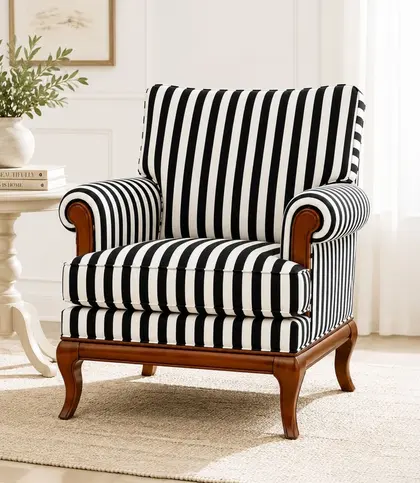
These current lounge chairs provide contemporary material and silhouette examples to compare with your brief. The catalog lists teak-wood frames with suede or velvet upholstery, and the product pages provide overall dimensions for room-planning checks.
They are shopping examples only. Do not treat them as originals, licensed reproductions, replicas of a named design, or evidence of historical provenance. Verify dimensions, upholstery care, seat feel, delivery access, and returns before choosing.

₹41,220
₹65,000
37%OFF
₹32,527
₹65,000
50%OFF

₹26,031
₹57,890
55%OFF

Final Verdict
- Use famous lounge-chair designs as well-documented visual reference points, not as automatic buying recommendations.
- Narrow the era and silhouette first, then decide whether you seek an original, authorised reproduction or style-inspired alternative.
- Only move forward when the chair’s scale, materials, room clearance and available provenance suit your brief.
FAQs
What makes a lounge-chair design famous or influential?
A design may become famous because it introduced a new material, construction approach or idea of relaxed seating; developed a recognisable silhouette; and has credible links to a designer, manufacturer, movement or documented production history. Visibility alone does not prove influence or quality.
Which design eras are associated with famous lounge chairs?
Common reference points include modernist, Scandinavian, mid-century and contemporary design. These labels overlap, and individual chairs can combine traits from more than one period or be produced later than the era that inspired them.
How can I tell an original lounge chair from a licensed reproduction?
Ask for the maker, production date, place of manufacture and documentation. An original should align with the claimed period and maker; a licensed reproduction should have evidence of authorised production. Compare labels, materials, dimensions and construction with reliable records.
What is the difference between a replica and a style-inspired lounge chair?
A replica aims to imitate a specific known design and may be unauthorised. A style-inspired chair uses broader cues from an era or visual language without claiming to be that specific design. Use the word replica only when the evidence supports it.
What dimensions should I check before buying a lounge chair?
Check overall width, depth and height, plus seat width, seat depth, arm height and ottoman dimensions where applicable. Also measure entrances, lifts, stairs, doorways and the route to the room, then assess the chair’s complete footprint in the layout.
Which materials are common in famous lounge-chair designs?
Common materials include leather, woven or upholstered fabric, moulded or bent wood, veneers, tubular metal and steel. Material alone does not establish age, quality or authenticity, so compare it with documented specifications and construction details.
How can I research the provenance of a lounge chair?
Start with the seller’s precise attribution, then request photos of labels, stamps, serial numbers, underside construction and restoration. Compare them with manufacturer catalogues, archives, museum records and reputable design references. Ownership records and past sales documentation can add useful context.
How much clearance does a lounge chair need in a room?
There is no single universal measurement. Allow enough space for people to move through the room and for doors, drawers and nearby furniture to function. Use the chair’s actual dimensions and your room’s traffic paths rather than relying on a generic rule.