


Best Laundry Basket: How to Choose the Right Style
Quick Answer
The best laundry basket fits your usual laundry volume, washing routine, carrying route, storage space and cleaning preferences. For most homes, start with a ventilated, stable, easy-to-clean basket with a firm base and comfortable, secure handles. Choose a divided, foldable, lidded or wheeled format only when sorting, storage, concealment or moving loads on level floors is your main need.
Definitions
Open laundry basket
A basket without a lid, allowing quick access and generally better airflow, but leaving laundry visible.
Divided laundry basket
A basket with separate compartments for sorting categories such as colours, fabrics, or household members before washing.
Lidded laundry basket
A basket with a cover that conceals laundry, though the lid may reduce ventilation and add handling steps.
Foldable laundry basket
A basket designed to collapse or flatten when not in use, useful where storage space is limited.
Wheeled laundry basket
A basket or basket-style carrier with wheels, intended to reduce lifting on suitable floors but potentially less practical on stairs or uneven surfaces.
Ventilation
The ability of air to circulate through the basket, helping damp garments avoid being left in a poorly aired container for long periods.
Best laundry basket: start with the decision, not the appearance
There is no single best laundry basket for every home. The right choice depends on how much laundry you collect, how often you wash, the route you carry it along, where it will be stored, and how easily it needs to be cleaned.
For general household use, a ventilated basket with a firm base, smooth interior and comfortable handles is a practical starting point. It is straightforward to load, carry and wipe down without adding features that may not solve a real problem.
Choose a different format when it addresses your main constraint: divided for regular sorting, foldable for limited empty-basket storage, lidded for concealment, or wheeled for heavier loads moved across clear, level floors.
- Start with your usual load and carrying route, rather than colour or decorative style.
- Prioritise a stable base, airflow and a filled weight you can manage.
- Let one clear need—sorting, storage, concealment or reduced lifting—guide extra features.
Compare laundry-basket formats by everyday use
Format affects daily use more than it may seem. An open basket is quick to fill and empty, and its openings often support airflow, but clothes remain visible. A lidded version can look tidier in a bedroom or bathroom, although opening the lid adds a step and ventilation may be more limited.
Divided designs can reduce sorting time before a wash, but each compartment offers less flexible space. They may also be heavier or more involved to clean than a simple single compartment. Choose one when separating loads is a consistent part of your routine.
Foldable baskets can be useful where a full-size basket would occupy valuable cupboard or floor space. Wheeled designs can reduce carrying effort on level floors, but need room to turn and store and are generally less useful on stairs.
- Open: easy access and typically better airflow; laundry stays visible.
- Divided: useful for regular sorting; less flexible capacity in each section.
- Lidded: conceals laundry; may limit airflow and slow access.
- Foldable: saves space when empty; inspect the frame, base and sides when open.
- Wheeled: reduces carrying on level routes; assess control, footprint and stairs.
Match capacity to household size and washing frequency
Capacity is not determined by household size alone. Clothing habits, towels, bedding, the number of collection points and washing frequency all affect the useful volume. Someone who washes small loads often may need less capacity than one person who collects towels and clothing for several days.
A small basket can work well for one person, light daily washing or a compact bedroom. A medium basket is often flexible for regular household routines. A large basket may suit family laundry or less frequent washing, but can become difficult to control once full.
Do not choose the largest option simply to avoid extra trips. If you use stairs, turn through narrow spaces or carry the basket any distance, choose a load you can lift and control comfortably. Leave enough room for lifting and airflow instead of compressing laundry to the top.
- Compare stated exterior dimensions with usable interior space.
- Consider bulky towels and bedding, not only everyday clothing.
- Choose a capacity you can carry comfortably when realistically full.
- Check that the basket fits its intended floor, cupboard or corner space.
Choose material for ventilation, durability, weight, and cleaning
Plastic is often lightweight and straightforward to wipe clean. Look for ventilation holes, a smooth finish and enough rigidity that the sides do not flex excessively while carrying a load. Rough moulding edges or sharp openings can catch delicate fabrics, so inspect the interior as well as the outside.
Fabric and cotton baskets can be light and easy to fold away. Check whether the lining or body is washable, how it should be dried, whether seams are reinforced, and whether the base retains its shape. A soft-sided basket can be convenient, but should remain controllable when picked up full.
Rattan and bamboo designs can offer a natural appearance and a more structured form. Their weave, finish, lining and care instructions matter, since textured or porous surfaces may take more effort to clean, especially if damp items are placed inside. Whatever the material, smooth interiors and secure edges help protect clothing.
- Plastic: commonly easy to wipe; check ventilation and rigidity.
- Fabric or cotton: often light and foldable; check washability, seams and base support.
- Rattan or bamboo: structured and decorative; inspect weave quality, lining and cleaning guidance.
- Any material: favour a smooth interior, neat edges and snag-free construction.
Check handles, shape, and stability before buying
Handles have a major effect on whether a basket feels manageable. They should be wide enough for a comfortable grip, securely fixed and positioned so the load remains balanced. Handles alone do not make an oversized or unevenly packed basket safe to carry.
A reinforced rim and firm base can make a full basket easier to control. Check that the base sits flat, then lightly press or nudge the basket to see whether it rocks or wobbles. Look for a shape that remains balanced when a typical load is placed inside.
Shape matters on the journey between rooms. A tall or wide basket may hold more, yet be awkward at doorways, corners and stair landings. Inspect seams, weave edges, holes, hinges and wheels for rough points that could snag clothes.
- Check handle width, attachment strength and balance.
- Look for a flat, firm base and a supportive rim.
- Test for rocking or wobble on a flat surface before relying on a tall or soft-sided shape.
- Avoid filling beyond a weight you can safely lift and control.
Plan for stairs, narrow routes, and limited storage
For stairs, prioritise a manageable filled weight, balanced handles and a shape that does not block your view or require awkward twisting. Where feasible, choose a load that can be controlled with one hand while the other remains available for the handrail. If this is not practical, reduce the load and make smaller trips.
A lightweight open or foldable basket may be more practical on stairs than a very large rigid or wheeled design, but the best choice depends on the route and your usual load. Wheels are generally not useful on steps and do not replace a manageable carrying weight.
Measure more than the space where the basket will sit. Check the narrowest doorway, hallway, turn, landing and cupboard opening it must pass through. For a foldable basket, compare its open measurements with its collapsed height, width and depth.
Wheels can help on smooth, level floors, particularly for heavier loads. Check that they roll smoothly, steer predictably, suit your flooring and leave enough room to turn and park.
- For stairs, favour a clear view, manageable weight and balanced handles.
- For narrow routes, measure every pinch point, including corners and landings.
- For compact storage, compare open and collapsed dimensions.
- For wheels, check floor compatibility, steering control and storage footprint.
A practical laundry-basket comparison checklist
Use this checklist before making a final choice. The most useful basket is not the one with the most features; it is the one that handles your routine with the fewest compromises.
- Capacity: Does it suit your normal load and washing frequency without encouraging overfilling?
- Ventilation: Can air circulate if laundry may sit for a while before washing?
- Portability: Are the handles comfortable, and is a full basket realistically liftable?
- Stability: Does the base sit flat, and does the basket stay balanced without rocking when loaded?
- Access: Can it pass through every doorway, turn, stair landing and storage opening?
- Cleaning: Are the surfaces, lining, seams and corners easy to wipe or wash?
- Storage: Does it fit the intended location, and can it collapse if space is limited?
- Clothing protection: Are there rough edges, exposed fasteners or gaps that could snag fabric?
Which laundry-basket format suits each household?
For one person or frequent washing, a small or medium ventilated basket is often enough. For family laundry or less frequent washing, a larger rigid basket can help only when the filled weight and carrying route remain manageable.
A divided basket suits a routine where pre-sorting saves meaningful time. In small rooms, a foldable basket can be useful when its collapsed dimensions fit the storage plan and, when open, its base sits flat, the sides hold their shape and it does not wobble under a typical load.
For stairs, favour a compact, balanced basket over maximum capacity or wheels. If concealment is the priority, a lidded basket can work well provided you are comfortable with the trade-off in airflow and immediate access.
- Frequent washing: small or medium, ventilated and easy to carry.
- Family or less frequent washing: larger and rigid, only if weight remains manageable.
- Pre-sorting: divided compartments when sorting saves meaningful time.
- Stairs: compact, balanced and light enough to control.
- Small rooms: foldable, after checking the base, load balance and wobble when open.
- Concealment: lidded, when a tidier appearance outweighs quick access.
FAQs
Basket choice is most reliable when capacity, route, storage space and construction are assessed together. Check product dimensions, care instructions, handle attachment and base shape against your own routine.
Compare current laundry-basket formats
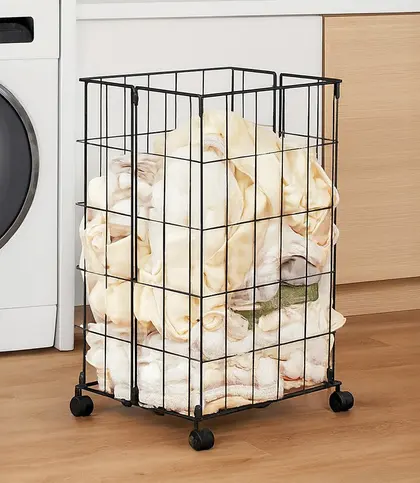
These current catalog examples cover a slim handled basket, a foldable linen basket, and a foldable iron-frame basket. Compare their product-page dimensions and construction with your wash load, route to the machine, stair use, ventilation needs, and available storage.
The product type confirms that each is a laundry basket, but capacity, washable components, load limit, and carrying comfort should still be verified for the exact variant.
 FastDelivery
₹1,424
₹2,999
53%OFF

Sold Out
₹749
₹1,499
50%OFF
₹2,639
₹6,598
60%OFF
Final Verdict
- For most homes, choose a ventilated, easy-to-clean basket with a firm, flat base and secure, comfortable handles.
- Choose divided for regular sorting, foldable for limited storage, lidded for concealment, or wheels for heavier loads on clear level floors. Reduce capacity when stairs, narrow access or lifting comfort make a full load difficult to control.
FAQs
What laundry-basket capacity suits my household?
Match capacity to your usual laundry volume and washing frequency, rather than household size alone. Small baskets can suit one person or frequent washing, medium baskets are flexible for many routines, and large baskets suit bigger or less frequent loads only if you can carry them comfortably.
Which laundry-basket material is easiest to clean?
A smooth plastic basket is often straightforward to wipe clean, especially when it has simple openings and few crevices. Fabric, rattan and bamboo can also work, but cleaning effort depends on the lining, weave, seams, finish and care instructions.
Are handles important on a laundry basket?
Yes. Well-positioned, securely attached handles make lifting and balancing easier. Check grip comfort along with the basket's filled weight, base shape and overall balance, because handles alone do not make an oversized load safe to carry.
What laundry basket is best for stairs?
For stairs, look for a lightweight, compact basket with a flat base, balanced handles and a shape that does not block your view. Where feasible, keep one hand available for the handrail and make smaller trips if a normal load is difficult to control. Wheels are generally less practical on steps.
Is a foldable laundry basket worth buying?
A foldable basket is worthwhile when empty-basket storage is a real issue. Check its collapsed measurements, frame or base support, handle strength and how it behaves when open: the base should sit flat, the sides should hold their shape and the basket should not wobble under a typical load.
Should I choose a divided or single-compartment basket?
Choose a divided basket if you regularly separate laundry before washing and will use the sections consistently. Choose a single compartment when you need the most flexible space, easier cleaning or a simpler, lighter design.
How do I measure space for a laundry basket?
Measure the intended storage spot for width, depth and height, then measure the narrowest doorway, hallway, corner, landing and cupboard opening on its route. For a foldable design, compare both open and collapsed dimensions.
How can I stop a laundry basket from tipping?
Choose a basket with a flat, firm base, a balanced shape and a supportive rim. Set it on a level surface and check for rocking or wobble, then distribute laundry evenly and avoid overfilling tall, narrow or soft-sided designs.