


1 Serving Spoon to Tablespoon: How to Measure It
Quick Answer
One serving spoon is not a fixed number of tablespoons because serving spoons vary in shape and volume. For a repeatable conversion, measure your specific spoon’s level brim capacity in millilitres, then divide by 15 for metric tablespoons, approximately 14.8 for US tablespoons, or 20 for Australian tablespoons.
Definitions
Serving spoon
A household utensil intended for serving food. Its capacity is not fixed across designs, materials, brands, or shapes.
Metric tablespoon
A tablespoon defined as 15 millilitres in many metric-based recipes.
US tablespoon
A tablespoon equal to approximately 14.8 millilitres; many practical kitchen references round this to 15 millilitres.
Australian tablespoon
A tablespoon defined as 20 millilitres.
Millilitre (ml)
A metric unit of volume used as the common starting point for measuring and converting a spoon’s capacity.
Quick Answer: One Serving Spoon Is Not Always a Fixed Number of Tablespoons
A serving spoon is a utensil category, not a standard volume measure. Two spoons that look similar can hold different amounts, so there is no universal conversion for “1 serving spoon to tablespoon.”
For a reliable result, measure the actual spoon in millilitres, identify the tablespoon standard used by the recipe, and divide the measured volume by that standard.
- Metric tablespoon: measured ml ÷ 15.
- US tablespoon: measured ml ÷ approximately 14.8.
- Australian tablespoon: measured ml ÷ 20.
Why a Serving Spoon Does Not Have One Universal Capacity
Serving spoons are made for serving and portioning food, rather than measuring a fixed volume. Their bowls vary in length, width, depth, curve, and intended use.
A shallow spoon and a deep spoon can appear similarly sized while holding different volumes. Do not infer capacity from the label “serving spoon,” its visual size, material, or cutlery category.
A serving spoon is useful for informal portioning, but it should not automatically replace the measuring tool specified in a recipe.
How to Measure a Serving Spoon’s Capacity in Millilitres
Measure the spoon’s level brim capacity, not a subjective everyday serving amount. Place the spoon bowl on a level surface or hold it steady and level, then fill it with water exactly to the rim without allowing water to dome above the edge.
Transfer the water to a vessel with fine millilitre graduations and read the level at eye height. A kitchen syringe can be useful when the volume is too small to read clearly in a jug. Minimise spills, and allow retained droplets to drain before reading.
If one level fill is difficult to read, measure several identical level fills into the vessel, divide the total volume by the number of fills, and record the approximate result. This gives the brim capacity of that particular spoon only.
A heaped, partial, thick, or packed serving is not equivalent to the measured brim capacity. Measure that actual serving separately if it is the amount you need to convert.
- Use water and a vessel with fine ml markings, or a kitchen syringe.
- Keep the spoon bowl level and fill precisely to the rim.
- Use several identical level fills when one fill is below the vessel’s readable resolution.
- Record the result as an approximate brim capacity in ml.
Convert the Measured Millilitres to Tablespoons
Use this formula: number of tablespoons = measured spoon capacity in ml ÷ ml per tablespoon. The correct divisor depends on the convention used by the recipe.
For example, if a spoon holds 30 ml when filled level to the rim, it equals 2 metric tablespoons because 30 ÷ 15 = 2. It equals about 2.03 US tablespoons because 30 ÷ 14.8 is about 2.03, and it equals 1.5 Australian tablespoons because 30 ÷ 20 = 1.5.
The spoon has not changed between these calculations; the tablespoon definition has. Round only when the recipe can tolerate a small difference.
- Metric: measured ml ÷ 15.
- US: measured ml ÷ approximately 14.8.
- Australian: measured ml ÷ 20.
Which Tablespoon Standard Does the Recipe Use?
Check the recipe’s country of origin, publisher notes, measurement system, or any stated millilitre definition. The word “tablespoon” does not always mean the same volume.
Many metric-based recipes use a 15 ml tablespoon. A US tablespoon is approximately 14.8 ml, though it is often rounded to 15 ml in everyday cooking. An Australian tablespoon is 20 ml.
If the source does not identify its convention and the quantity matters to the outcome, check its measurement guidance or measure the ingredient directly with the stated tool.
- Metric tablespoon: 15 ml.
- US tablespoon: approximately 14.8 ml.
- Australian tablespoon: 20 ml.
When to Use a Proper Measuring Tool Instead
A measured serving spoon may be adequate for casual cooking or informal portioning where a slight difference will not noticeably affect the dish.
Use a proper measuring spoon, syringe, or graduated vessel when a recipe depends on a precise ratio. This is especially important for baking, confectionery, preserves, concentrated sauces, and small quantities of strong ingredients.
For the most repeatable outcome, measure the ingredient directly with the volume tool stated in the recipe instead of converting an everyday serving utensil.
- Use precise tools when texture, setting, balance, or preservation depends on the amount.
- Use a serving spoon only for approximate portions when the recipe allows flexibility.
- Do not treat a brim-capacity measurement as the volume of a heaped or partial serving.
Serving Spoon to Tablespoon Conversion Checklist
This short process avoids guessing from a spoon’s shape and gives you a conversion based on your own utensil.
- Fill the specific spoon level to its rim with water and measure its brim capacity in ml.
- Use fine graduations, a syringe, or several identical fills if one fill is hard to read.
- Confirm whether the recipe uses metric, US, or Australian tablespoons.
- Divide the ml value by 15, approximately 14.8, or 20 as applicable.
- Use the recipe’s stated measuring tool when precision or repeatability matters.
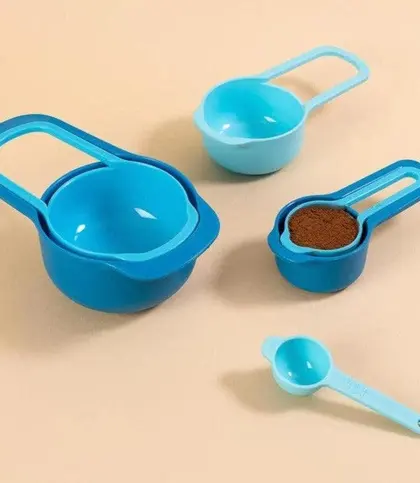
Measure with a marked spoon
For repeatable recipe quantities, use a labelled measuring spoon rather than assuming a serving spoon holds one tablespoon. Check the set's included capacities before buying.
₹295

Final Verdict
- There is no single conversion for one serving spoon to tablespoons because serving spoons are not standardised.
- For a repeatable conversion, measure the individual spoon’s level brim capacity in millilitres, then divide by 15 ml for metric, approximately 14.8 ml for US, or 20 ml for Australian tablespoons.
- A heaped or partial serving must be measured separately. When accuracy matters, measure the ingredient directly with an appropriate volume tool.
FAQs
Is a serving spoon a standard unit of measurement?
No. A serving spoon is a household utensil category, and its volume varies by shape and design. It has no fixed tablespoon value unless that specific spoon is measured.
How can I measure a serving spoon’s capacity in millilitres?
Measure its level brim capacity: keep the spoon bowl level, fill water exactly to the rim without doming it, and transfer the water to a finely graduated ml vessel or a kitchen syringe. If one fill is too small to read clearly, measure several identical level fills, divide the total by the number of fills, and minimise spills and retained droplets.
How many tablespoons are in one serving spoon?
It depends on the measured capacity of that spoon and the recipe standard. For example, a level brim capacity of 30 ml equals 2 metric tablespoons, about 2.03 US tablespoons, or 1.5 Australian tablespoons.
Which tablespoon standard does my recipe use?
Check the recipe’s country, publisher notes, or stated ml definition. Metric recipes commonly use 15 ml, US recipes use approximately 14.8 ml, and Australian recipes use 20 ml.
How do I convert millilitres to metric tablespoons?
Divide the measured volume in millilitres by 15. For example, 45 ml ÷ 15 equals 3 metric tablespoons.
How do I convert millilitres to US tablespoons?
Divide the measured volume in millilitres by approximately 14.8. In everyday cooking, US tablespoons are often rounded to 15 ml, but approximately 14.8 ml is more precise.
What measuring tool should I use for recipe accuracy?
Use a proper measuring spoon, kitchen syringe, or graduated measuring vessel. This is particularly important for baking, confectionery, preserves, concentrated sauces, and recipes where small differences affect the result.